Q9 · One-sided limit of a piecewise function
Pick the right piece, then plug in. That's the whole game.
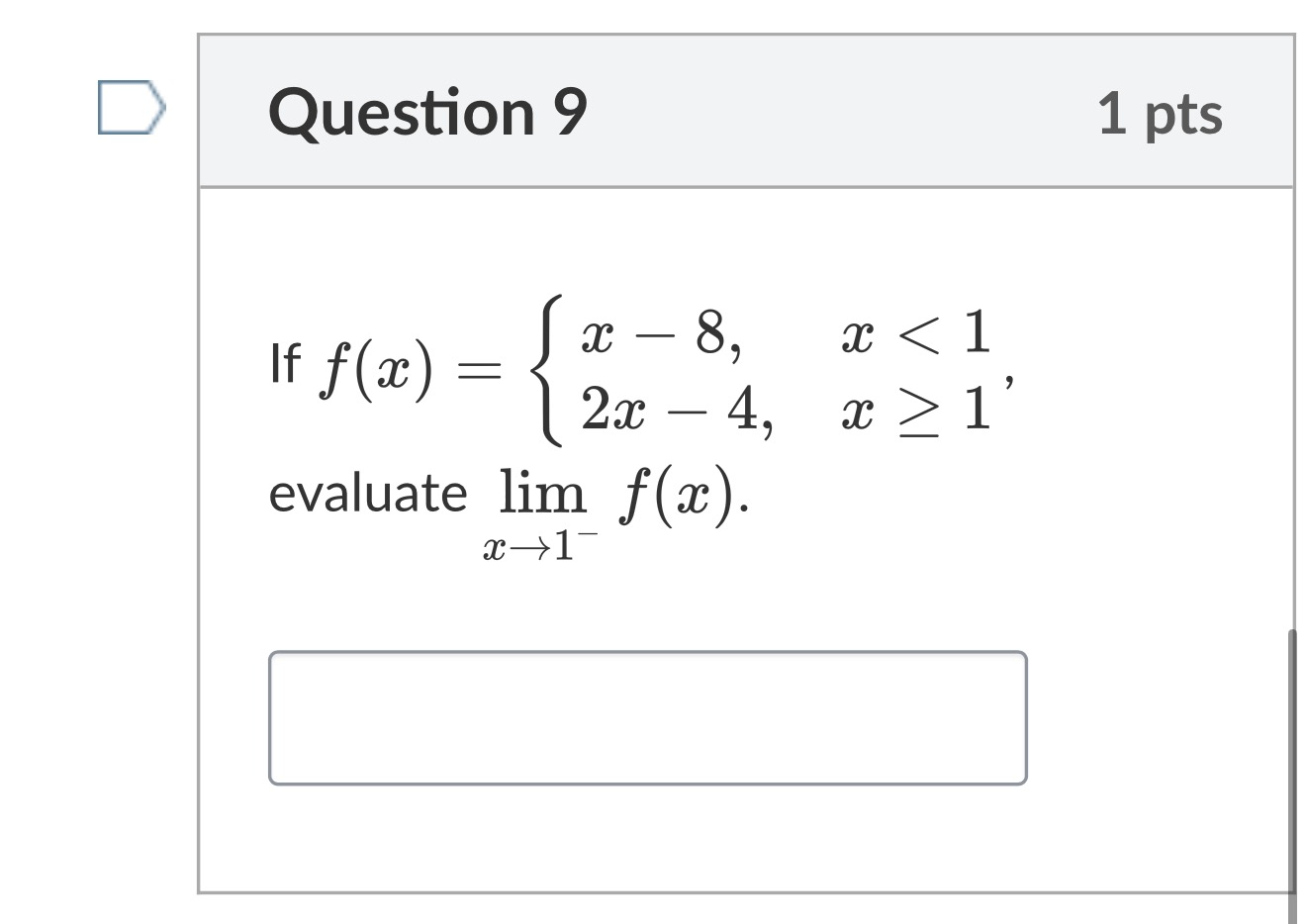
1. Intuition — what is $\lim_{x \to 1^-} f(x)$ asking?
The minus sign in the superscript $1^-$ is the whole question. It says: as $x$ gets close to 1, but only from the left side (values less than 1), what value is $f(x)$ approaching?
Picture yourself walking along the $x$-axis from the left, getting closer and closer to $x=1$ without ever stepping on it. What $y$-value are you seeing? That's the left-hand limit.
The piecewise definition tells you: when you're on the left side of 1, you're in the "$x-8$" region. So we use that piece. The right-hand piece "$2x-4$" is irrelevant for a left-hand limit — it's the answer to a different question.
🌉 Where this fits in the pretest arc
Q5 introduced one-sided limits with a piecewise graph. Q9 is the same idea, but the function is given as a formula, not a picture. Same concept, different representation. If you can read a piecewise function and pick the right piece, you can answer this in one line.
Pattern across the pretest: Q4 (continuity definition) → Q5 (one-sided limits, picture) → Q8 (removable discontinuity) → Q9 (one-sided limits, formula). The tools repeat with new packaging.
2. The piecewise function — read it carefully
$f(x) = $
| $x - 8$ | when $x < 1$ |
| $2x - 4$ | when $x \geq 1$ |
The two pieces "stitch together" at $x=1$. On the left of 1, the function is the line $y = x-8$. On the right (and at 1 itself), it's the line $y = 2x-4$. The left piece is undefined for $x \geq 1$, the right piece is undefined for $x < 1$ — they live in different "rooms."
3. The rule — pick the right piece first
For a left-hand limit $\lim_{x \to a^-}$, you only care about the piece whose domain includes values arbitrarily close to $a$ from the left. In our case:
- $x \to 1^-$ means $x$ is approaching 1 from values less than 1.
- The piece "$x-8$ when $x < 1$" matches — those are exactly the values we're using.
- The piece "$2x-4$ when $x \geq 1$" doesn't match — we never enter that room on a left-hand approach.
So we work with $f(x) = x - 8$. Now it's just a polynomial — plug in.
4. Worked solution — plug in $x = 1$
For a left-hand limit, once you've picked the right piece, the function is continuous in a neighborhood of $a$ (from that side), so the limit is just plug in the value:
$$\lim_{x \to 1^-} f(x) = \lim_{x \to 1^-} (x - 8) = 1 - 8 = \boxed{-7}$$
Three steps, all of them obvious once you've picked the right piece:
- Identify the side: $x \to 1^-$ means $x < 1$ neighborhood.
- Pick the matching piece: $f(x) = x - 8$.
- Plug in $x = 1$: $1 - 8 = -7$.
5. What about the right-hand limit?
$\lim_{x \to 1^-} f(x) = 1 - 8 = \mathbf{-7}$
Uses the "$x-8$" piece.
$\lim_{x \to 1^+} f(x) = 2(1) - 4 = \mathbf{-2}$
Uses the "$2x-4$" piece.
The two one-sided limits disagree ($-7 \neq -2$), so the full two-sided limit $\lim_{x \to 1} f(x)$ does not exist. (That's a Q5-style jump discontinuity, by the way — same idea, different shape.)
Notice the actual value of the function at $x=1$: it's defined by the second piece, so $f(1) = 2(1) - 4 = -2$. The function is continuous from the right (and at the point itself), but discontinuous from the left.
6. The trap — what students get wrong
7. Visualizing the jump
Plot the two pieces in your head:
- Line 1: $y = x - 8$ for $x < 1$. At $x = 0$, $y = -8$. At $x = 1$, $y = -7$ (approached, not reached). A line with slope 1, $y$-intercept $-8$, open circle at $(1, -7)$.
- Line 2: $y = 2x - 4$ for $x \geq 1$. At $x = 1$, $y = -2$ (closed dot). At $x = 2$, $y = 0$. A line with slope 2, $y$-intercept $-4$, closed dot at $(1, -2)$.
The two lines come from the left and right, and at $x = 1$ they jump from $y = -7$ (left side limit) to $y = -2$ (right side value, and right side limit). A 5-unit gap. The graph of $f$ literally has a "step" at $x = 1$.
When you compute a gradient through a ReLU network, you hit exactly the kind of piecewise structure in Q9 — and you need to know which piece you're in to take the derivative (or the subgradient, in the non-differentiable case). This is the same logic as Q9: pick the right piece, then proceed.
8. Check your understanding
Mini-question. If $g(x) = \begin{cases} 3x + 1, & x \leq 2 \\ x^2, & x > 2 \end{cases}$, find $\lim_{x \to 2^+} g(x)$.
Show answer
$x \to 2^+$ means $x > 2$ neighborhood. Pick the "$x^2$" piece. Plug in: $2^2 = 4$.
Note the inequality flip: "$x \leq 2$" includes 2 itself, but the right-hand limit uses $x > 2$, so we use the second piece. Boundary value (at $x=2$) is $3(2)+1 = 7$ — different from the right-hand limit, different from the left-hand limit. Full two-sided limit at $x=2$ doesn't exist.
9. Practice problems
-
If $h(x) = \begin{cases} 5 - x, & x < 0 \\ x^2, & x \geq 0 \end{cases}$, find $\lim_{x \to 0^-} h(x)$.
Show answer
Left-hand limit. Use "$5-x$" piece. Plug in $x=0$: $5-0 = 5$. So $\lim_{x\to 0^-} h(x) = 5$. -
Two-sided. For the same $h(x)$, does $\lim_{x \to 0} h(x)$ exist? Why or why not?
Show answer
Right-hand limit: $x^2$ at $x=0$ is $0$. Left-hand limit (from #1) is $5$. They disagree, so the two-sided limit does not exist. Discontinuous at $x=0$. -
Real-world. A phone plan charges $\$30$ for the first 100 minutes, then $\$0.10$/minute beyond. Write a piecewise function $C(t)$ for cost in dollars as a function of $t$ minutes, and find $\lim_{t \to 100} C(t)$. Does the limit exist?
Show answer
$C(t) = \begin{cases} 30, & 0 \leq t \leq 100 \\ 30 + 0.10(t-100), & t > 100 \end{cases}$.
Left limit at $t=100$: $C(100^-) = 30$. Right limit at $t=100$: $30 + 0.10(0) = 30$. Both equal $30$, so the two-sided limit exists and equals $30$.
Notice: $C(100) = 30$ (the first piece defines it at the boundary). So the function is continuous at $t=100$ — no jump. The plan "transitions smoothly" from a flat rate to a per-minute rate.
10. Takeaways
- One-sided limit recipe: identify the side, pick the matching piece, plug in.
- $\lim_{x \to a^-} f(x)$ uses the piece whose domain includes $x < a$ (the left neighborhood).
- If the two one-sided limits disagree, the full two-sided limit does not exist — that's a jump discontinuity.
- Piecewise functions are everywhere in DS: ReLU, decision trees, step activations, loss functions, billing tiers, tax brackets.
- The Q5 → Q9 pattern: same one-sided limit idea, picture vs. formula. Once you can do both, you're fluent.
© Data Science Tutor · datascience.aidalee.com