Q10 · Indeterminate limit via factoring
Plug in directly, get $0/0$, panic, factor, win.
1. Intuition — what does the question ask?
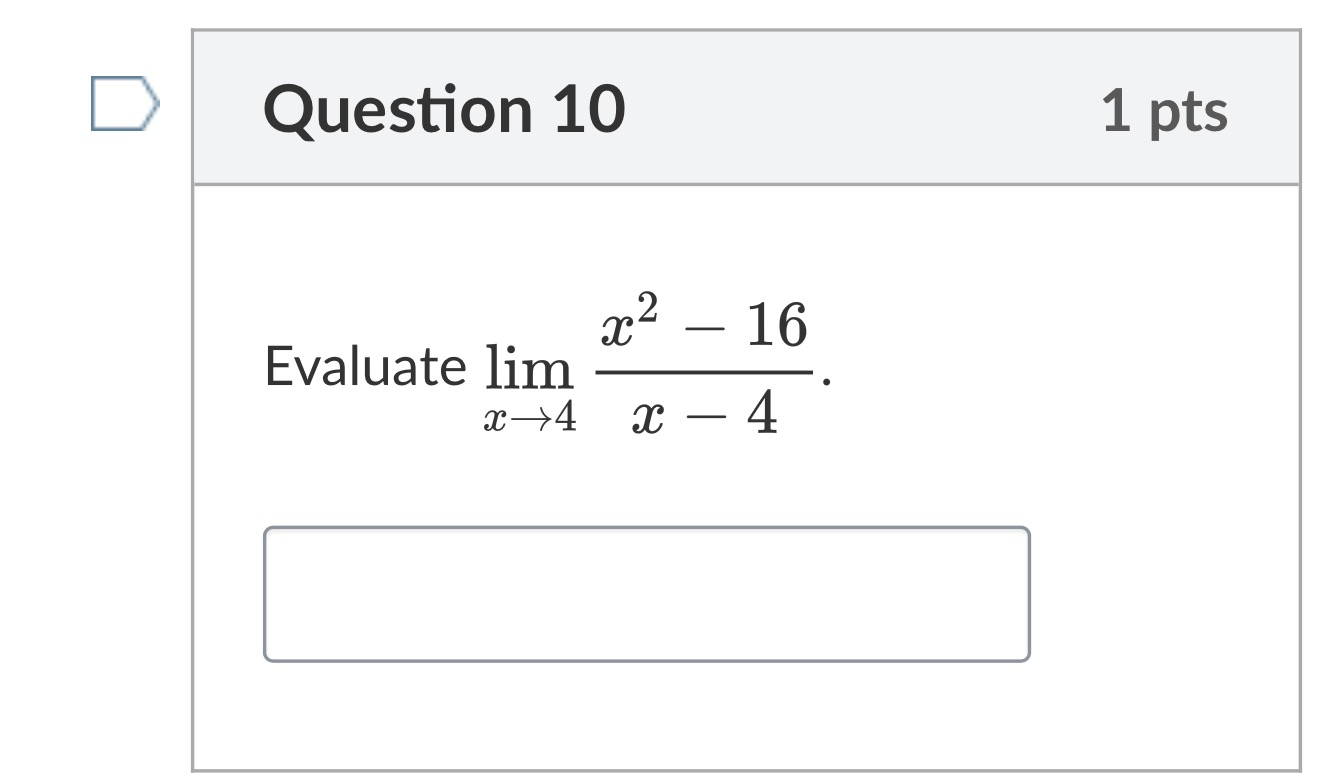
We need the limit as $x \to 4$ of a rational function. The first instinct: just plug in $x=4$. But if you do, the numerator is $4^2 - 16 = 0$ and the denominator is $4 - 4 = 0$, so the expression becomes $\frac{0}{0}$ — undefined.
The function is not actually undefined everywhere — just at $x=4$ specifically. For every $x$ near 4 (but not equal to 4), the function has a real value, and as $x$ gets close to 4, those values approach a single number. The question is: what number?
Same shape as Q8: the function has a hole at $x=4$, and we want to know the height of that hole. The only difference from Q8 is that Q8 told us the answer (it was asking us to fill the hole), while Q10 makes us find the answer ourselves. Same problem, different framing.
🌉 The Q8 ↔ Q10 ↔ Q6 triangle
Three questions, one algebraic pattern, three different ways of asking it:
- Q8: "What's the value at the hole?" — answer 10. Function: $\frac{x^2-25}{x-5}$.
- Q10 (this one): "What's the limit at the hole?" — answer 8. Function: $\frac{x^2-16}{x-4}$.
- Q6: "What's the derivative at a point?" — answer 12. The derivative IS a limit of a similar shape: $\lim_{h\to 0} \frac{f(x+h) - f(x)}{h}$.
All three are limits where "plugging in gives 0/0" — an indeterminate form. The fix is the same: factor and cancel, then plug in.
2. The 0/0 trap — why "just plug in" fails
The seven classical indeterminate forms: $\frac{0}{0}$, $\frac{\infty}{\infty}$, $0 \cdot \infty$, $\infty - \infty$, $0^0$, $1^\infty$, $\infty^0$. Each one needs a different technique. For $\frac{0}{0}$ rational functions, the standard first move is factor and cancel (this question), and if that fails, you escalate to L'Hôpital's rule (Calc II).
3. The fix — factor the numerator
The numerator $x^2 - 16$ is a difference of squares:
$$x^2 - 16 = x^2 - 4^2 = (x-4)(x+4)$$
So the original expression becomes:
$$\frac{x^2 - 16}{x - 4} = \frac{(x-4)(x+4)}{x-4}$$
For $x \neq 4$, the $(x-4)$ factors cancel:
$$= x + 4 \quad \text{(for } x \neq 4\text{)}$$
The cancellation is only legal for $x \neq 4$ — we cannot divide by zero. But the cancellation tells us that the function, near 4, looks exactly like the simple line $y = x + 4$.
4. Take the limit — now plugging in works
For $x \neq 4$ but $x$ close to 4, the function equals $x + 4$. As $x \to 4$:
$$\lim_{x \to 4} \frac{x^2 - 16}{x - 4} = \lim_{x \to 4} (x + 4) = 4 + 4 = \boxed{8}$$
The "hole" at $x=4$ sits at height $y=8$. The function is undefined exactly at $x=4$, but the limit — the value the function is approaching — is 8.
5. Numerical sanity check — what does the function look like near 4?
A good way to convince yourself the answer is 8: plug in values approaching 4 from both sides, see the function approach 8.
| $x$ | 3.9 | 3.99 | 3.999 | 4.001 | 4.01 | 4.1 |
|---|---|---|---|---|---|---|
| $\frac{x^2-16}{x-4}$ | 7.9 | 7.99 | 7.999 | 8.001 | 8.01 | 8.1 |
As $x$ approaches 4 from either side, the function value approaches 8. The hole is at $y=8$, exactly as our algebra says.
6. Q8 vs Q10 — same problem, different question
| Q8 | Q10 (this one) | |
|---|---|---|
| Function | $g(x) = \frac{x^2-25}{x-5}$ for $x \neq 5$ | $f(x) = \frac{x^2-16}{x-4}$ (everywhere it makes sense) |
| Question | What value of $g(5)$ makes $g$ continuous? | Evaluate $\lim_{x \to 4} f(x)$ |
| Algebra | Factor: $x^2-25 = (x-5)(x+5)$, cancel, get $x+5$ | Factor: $x^2-16 = (x-4)(x+4)$, cancel, get $x+4$ |
| Evaluate at hole | $5+5 = 10$ | $4+4 = 8$ |
| Answer | $g(5) = 10$ | limit $= 8$ |
These two questions use the same algebraic template — difference of squares over a linear term — and run the same factor-cancel-evaluate recipe. The only difference is what the question is asking: Q8 wants the function value at the hole; Q10 wants the limit at the hole. And for a removable discontinuity, the limit equals the value that would make the function continuous — they're the same number computed two ways.
7. The 0/0 ↔ derivative connection (Q6 prep)
Q6 asked for $f'(-3)$ for $f(x) = -2x^2$ using the power rule. The reason the power rule works is the derivative is defined as a 0/0 limit:
$$f'(a) = \lim_{h \to 0} \frac{f(a+h) - f(a)}{h}$$
For $f(x) = x^2$ at $a = 3$:
$$f'(3) = \lim_{h \to 0} \frac{(3+h)^2 - 9}{h} = \lim_{h \to 0} \frac{9 + 6h + h^2 - 9}{h} = \lim_{h \to 0} \frac{6h + h^2}{h} = \lim_{h \to 0} (6 + h) = 6$$
Same dance: factor out the $h$, cancel, take the limit, get a clean answer. Q10 and the derivative definition use the same 0/0 technique. Master this question and you've mastered the first step of every derivative proof.
8. Check your understanding
Mini-question. Evaluate $\lim_{x \to 3} \dfrac{x^2 - 9}{x - 3}$.
Show answer
$x^2 - 9 = (x-3)(x+3)$, so $\frac{x^2-9}{x-3} = x+3$ for $x \neq 3$. Limit: $3+3 = 6$.
Same template, different numbers. The pattern is: difference of squares, factor, cancel, plug in.
9. Practice problems
-
Evaluate $\lim_{x \to 2} \dfrac{x^2 - 4}{x - 2}$.
Show answer
$x^2 - 4 = (x-2)(x+2)$, cancel: $x+2$. Limit: $2+2 = 4$. -
Different factoring. Evaluate $\lim_{x \to 5} \dfrac{x^2 - 3x - 10}{x - 5}$. (Hint: the numerator factors as a product, not a difference of squares.)
Show answer
$x^2 - 3x - 10 = (x-5)(x+2)$ — find two numbers that multiply to -10 and add to -3: that's -5 and 2. Cancel $x-5$: $x+2$. Limit: $5+2 = 7$.
Same pattern, but you have to recognize the quadratic trinomial factorization. This is the trick that comes up most often on tests. -
Variation. Evaluate $\lim_{x \to 4} \dfrac{x - 4}{\sqrt{x} - 2}$. (Hint: when you don't see a difference of squares in the numerator, try multiplying by the conjugate.)
Show answer
Multiply top and bottom by $\sqrt{x} + 2$: $$\frac{(x-4)(\sqrt{x}+2)}{(\sqrt{x}-2)(\sqrt{x}+2)} = \frac{(x-4)(\sqrt{x}+2)}{x-4} = \sqrt{x}+2$$ for $x \neq 4$. Limit: $\sqrt{4}+2 = 4$.
The conjugate trick is the next tool after factoring — it works for $\sqrt{}$ differences that don't have a polynomial factorization.
10. Takeaways
- 0/0 indeterminate form: when plugging in gives $\frac{0}{0}$, you cannot read off the limit from the algebraic structure alone. You have to do work.
- For rational functions, the first move is factor and cancel. Difference of squares ($a^2 - b^2 = (a-b)(a+b)$) and quadratic trinomials are the two factoring patterns you'll see 90% of the time.
- After canceling, plug in. The limit equals the simplified form evaluated at the hole.
- Q8, Q10, and the derivative definition are all the same 0/0 algebra — different numbers, same template. Master this and you've mastered the first move of every derivative proof.
- If factoring doesn't work, the next tool is the conjugate trick (problem #3 above) or L'Hôpital's rule (Calc II).
- DS connection: this exact 0/0 pattern shows up in likelihood ratios, log-of-zero, $\sin(x)/x$ at zero, and the definition of every derivative. Same recipe every time.
© Data Science Tutor · datascience.aidalee.com