Q8 · Removable discontinuity
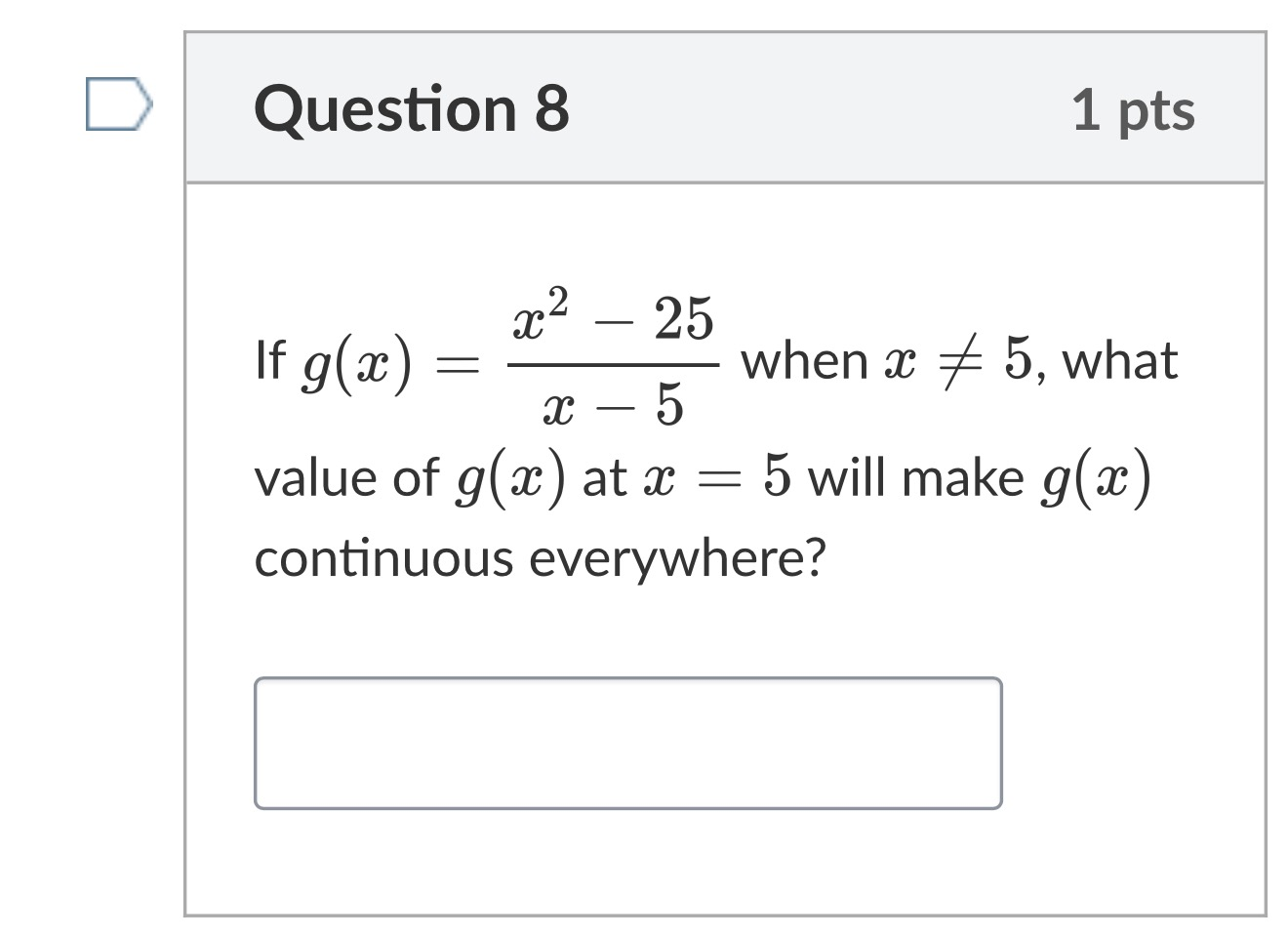
Plug the hole: which value makes $g$ continuous at $x=5$?
1. Intuition — what does the question actually ask?
The function $g(x) = \dfrac{x^2-25}{x-5}$ is defined everywhere except $x=5$ (you can't divide by zero). So at $x=5$, the function has a "hole" — a missing point. The question: if we get to pick any value for $g(5)$ that we want, what value fills the hole smoothly so the function is continuous?
The trick is that the algebra almost works out. $x^2-25$ and $x-5$ share a factor, and once we cancel, the answer is obvious. But the cancellation is illegal at $x=5$ (we'd be dividing by zero), so we need a careful two-step dance: simplify for $x \neq 5$, then ask what the simplified function approaches as $x \to 5$.
🌉 Where this question sits in the pretest arc
Q4 introduced the 3-condition test for continuity. Q5 looked at one-sided limits (jumps). Q8 introduces the third kind of discontinuity — the removable discontinuity (a hole), so called because you can "remove" it by filling in one single value.
The three flavors of discontinuity, in plain language:
- Removable (Q8) — a hole. Fill it with one number and continuity is restored.
- Jump (Q5) — left and right limits disagree. No single value can fix it.
- Infinite (Q4's cousin) — function shoots to $\pm\infty$. Not continuous, not removable.
2. The 3-condition continuity test (Q4 recap)
A function $g$ is continuous at $x = a$ if and only if all three hold:
At $x=5$ right now, condition 1 fails — $g(5)$ is undefined (denominator is 0). The question is asking: if we define $g(5)$ to be the value that makes condition 3 hold, what value do we need?
3. The algebra — factor and cancel
$g(x) = \dfrac{x^2 - 25}{x - 5}$ for $x \neq 5$
The numerator is a difference of squares: $x^2 - 25 = x^2 - 5^2 = (x-5)(x+5)$.
So for $x \neq 5$: $\;g(x) = \dfrac{(x-5)(x+5)}{x-5} = x + 5$
Important: the cancellation is only valid when $x \neq 5$. At $x=5$ we still have $\frac{0}{0}$ — an indeterminate form, not a real number. But the cancellation tells us what the function is near 5.
4. Take the limit — the value the function approaches
For $x \neq 5$, $g(x) = x + 5$. The limit as $x \to 5$ is straightforward:
$$\lim_{x \to 5} g(x) = \lim_{x \to 5} (x + 5) = 5 + 5 = 10$$
Even though $g(5)$ is undefined, the function is heading toward $10$ from both sides. So if we define $g(5) = 10$, the function becomes continuous — the hole gets filled.
5. Why 10 — the unifying idea
The continuity test says: the value we plug in must equal the limit. The limit, after we simplify the algebra, is $x+5$, evaluated at $5$, which is $10$. That's the unique value that makes $g$ continuous. Any other value (say, 7, or 100) would leave a "filled hole" that's still discontinuous — the curve would have a single out-of-place point.
$\boxed{g(5) = 10}$ is the answer. It's the value the rest of the function was "trying" to be at $x=5$.
6. The picture — what the graph actually looks like
$g(x) = \dfrac{x^2-25}{x-5}$ looks like the line $y = x + 5$ — but with a hole punched at the point $(5, 10)$. The line is the "filled-in" version; the original function is the line minus that one point.
Sketch (in your head or on paper):
Draw the line $y = x + 5$ from $(0, 5)$ through $(1,6), (2,7), (3,8), (4,9), \ldots, (10, 15)$.
Now punch a small open circle at the point $(5, 10)$.
That's the whole graph — a straight line, with one point missing. The function is "trying" to be 10 there, but undefined.
If a graph were provided with the question, it would be embedded here. Since this one is text-only, the sketch above is your reference.
df.fillna(limit_value) — but the *right* value to fill with is usually the limit of the surrounding data, not zero. Q8 is the same problem in miniature: identify the limit (10), then plug it in. Same logic, single-variable form.
7. Check your understanding
Mini-question. $h(x) = \dfrac{x^2 - 9}{x - 3}$ for $x \neq 3$. What value of $h(3)$ makes $h$ continuous everywhere?
Show answer
$x^2 - 9 = (x-3)(x+3)$, so $h(x) = x+3$ for $x \neq 3$. Limit as $x \to 3$ is $3+3 = 6$. So $h(3) = 6$.
The pattern: factor, cancel, evaluate the simplified form at the bad point. Works for any rational function where the numerator has the denominator's factor.
8. Practice problems
-
$f(x) = \dfrac{x^2 - 1}{x - 1}$ for $x \neq 1$. What value makes $f$ continuous at $x=1$?
Show answer
$x^2 - 1 = (x-1)(x+1)$, so $f(x) = x+1$ for $x \neq 1$. Limit: $1+1 = 2$. So $f(1) = 2$. -
Harder. $f(x) = \dfrac{x^2 - 7x + 12}{x - 4}$ for $x \neq 4$. Fill the hole.
Show answer
$x^2 - 7x + 12 = (x-3)(x-4)$. Cancel $x-4$: $f(x) = x - 3$ for $x \neq 4$. Limit: $4-3 = 1$. So $f(4) = 1$.
Trick here: the numerator factors as a product, not a difference of squares. Recognize quadratic trinomials: $x^2 - 7x + 12$ — find two numbers that multiply to 12 and add to -7: that's -3 and -4, so $(x-3)(x-4)$. -
Connection. For $f(x) = \dfrac{x^2 - 25}{x + 5}$ (note: plus 5), $f(-5)$ would have to be
______to make $f$ continuous. What changes from Q8?Show answer
$x^2 - 25 = (x-5)(x+5)$. Cancel $x+5$: $f(x) = x-5$ for $x \neq -5$. Limit: $-5-5 = -10$. So $f(-5) = -10$.
Nothing changes in method — the sign in the denominator just changes which root is "bad." The same factor-cancel-evaluate recipe works for any removable discontinuity at any point.
9. Takeaways
- Removable discontinuity = "hole in the graph" = numerator and denominator share a factor.
- Fix: factor the numerator, cancel the bad factor (valid for $x \neq a$), take the limit, plug in the limit at the bad point.
- Recipe:
factor → cancel → evaluate simplified form at the hole → done. - The three flavors of discontinuity: removable (Q8, fix with one value), jump (Q5, no fix), infinite (Q4 cousin, not removable).
- DS connection: same pattern as pandas
fillna(limit)for missing data.
© Data Science Tutor · datascience.aidalee.com