Limits · Pretest Q5
One-sided limits, jump discontinuities, and the missing half of the continuity story
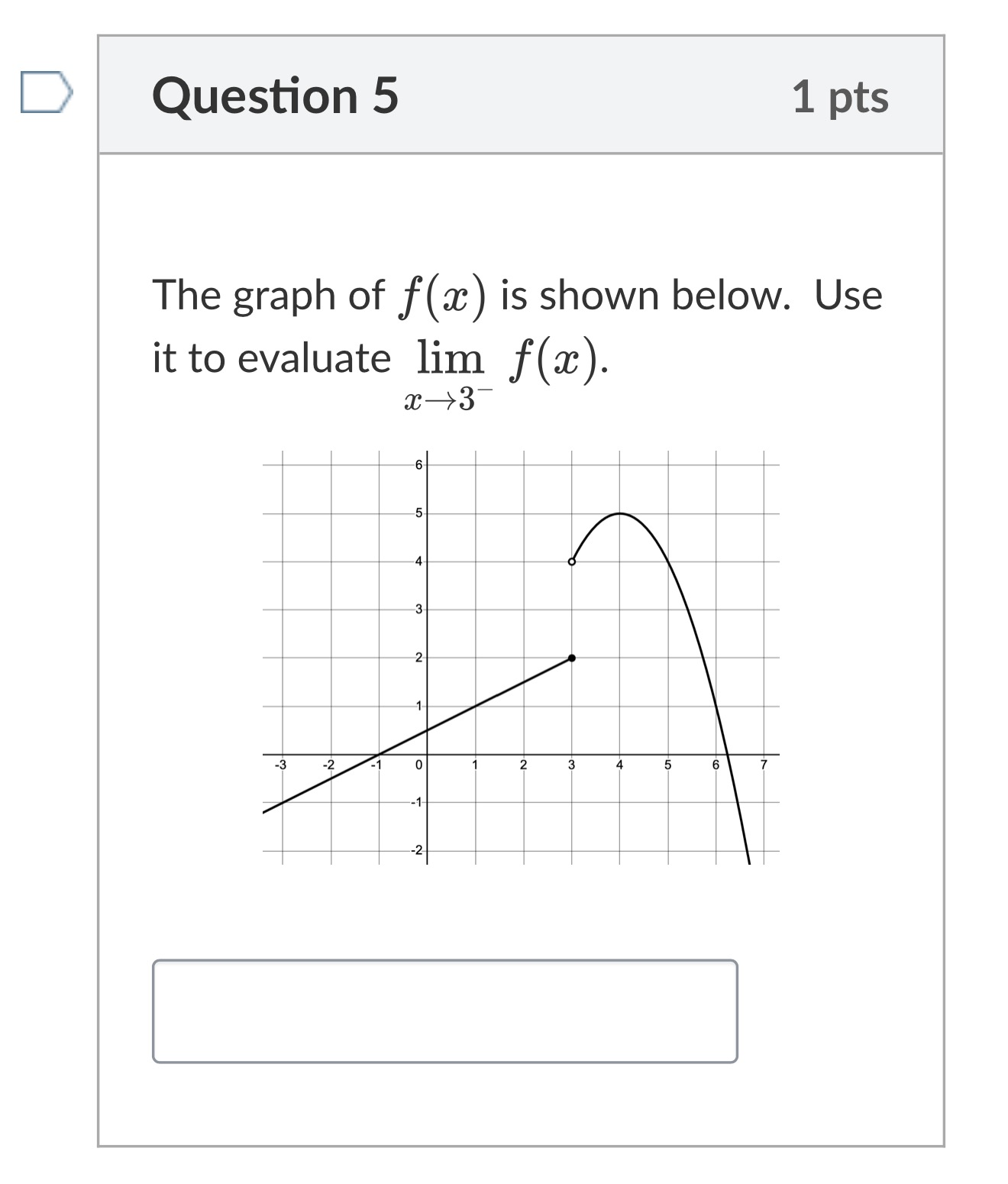
The graph of $f(x)$ is shown below. Use it to evaluate $\displaystyle\lim_{x \to 3^-} f(x)$.
1 · The intuition
The little $\boldsymbol{-}$ superscript on $\to 3^-$ is the key symbol here. It means "approach 3 from the left side only" — i.e., $x$ values like $2.9$, $2.99$, $2.999$, getting closer to $3$ but staying strictly less than $3$.
The little $\boldsymbol{+}$ (which you'll see in the next problem) means "from the right."
One-sided limits matter because a function can behave differently on the left of a point than on the right. In Q4, the function matched on both sides; in Q5, the two sides disagree at $x=3$. The notation lets you ask about each side separately.
2 · Notation
For a function $f$ and a point $x = a$:
| Notation | Name | What you're asking |
|---|---|---|
| $\displaystyle\lim_{x \to a^-} f(x)$ | Left-hand limit | What does $f$ approach as $x$ gets close to $a$ from below (from the left)? |
| $\displaystyle\lim_{x \to a^+} f(x)$ | Right-hand limit | What does $f$ approach as $x$ gets close to $a$ from above (from the right)? |
| $\displaystyle\lim_{x \to a} f(x)$ | Two-sided limit | Both one-sided limits exist and equal the same value. |
The two-sided limit exists if and only if both one-sided limits exist and agree:
$$\lim_{x \to a} f(x) = L \quad \iff \quad \lim_{x \to a^-} f(x) = L \;\text{ and }\; \lim_{x \to a^+} f(x) = L$$3 · Worked solution
For $\displaystyle\lim_{x \to 3^-} f(x)$ in the graph above:
Step 1 — Identify which piece of the function matters.
The "from the left" means we ignore everything to the right of $x = 3$. So we look at the linear piece that ends at the closed dot at $(3, 2)$.
Step 2 — Trace the linear piece toward $x = 3$.
The line has equation $y = \dfrac{2}{3}x$ (slope $\tfrac{2}{3}$, passes through $(-1, 0)$). As $x \to 3^-$:
$$f(x) \to \frac{2}{3}(3) = 2$$The line approaches the closed dot at $(3, 2)$. So the left-hand limit is $2$.
Step 3 — Note: the open circle does NOT matter for this question.
The open circle at $(3, 4)$ is on the right side of $x = 3$. It would matter for $\lim_{x \to 3^+} f(x)$, but not for the left-hand limit. The closed dot is what we approach from the left.
4 · What about the right-hand limit? (bonus, not asked)
For the same function, the right-hand limit $\lim_{x \to 3^+} f(x)$ would be 4 — the curve approaches the open circle from the right.
So the two one-sided limits disagree:
$$\lim_{x \to 3^-} f(x) = 2 \quad \neq \quad 4 = \lim_{x \to 3^+} f(x)$$Which means the two-sided limit $\lim_{x \to 3} f(x)$ does not exist. The function "jumps" from $y = 2$ to $y = 4$ at $x = 3$.
5 · Connection to Q4 — the jump discontinuity
Compare Q4 and Q5 in terms of the 3-condition continuity test:
| Condition | Q4 at $x = 3$ | Q5 at $x = 3$ |
|---|---|---|
| 1. $f(3)$ is defined | ✓ Yes ($= 2$) | ✓ Yes ($= 2$) |
| 2. $\lim_{x \to 3} f(x)$ exists | ✓ Yes ($= 5$) | ✗ No — left = 2, right = 4 |
| 3. $f(3) = \lim f(x)$ | ✗ (different values) | ✗ (limit doesn't exist) |
| Type of discontinuity | Removable (cond 3 fails) | Jump (cond 2 fails) |
Q5 is the textbook example of a jump discontinuity: both one-sided limits exist (they're finite numbers), but they don't agree. There's a literal jump in the graph — your pen has to leave the page and reconnect at a different height.
6 · Common traps
- Confusing the closed dot with the open circle. The closed dot at $(3, 2)$ is what the left-hand limit approaches. The open circle at $(3, 4)$ is what the right-hand limit approaches. If you wrote $4$, you read the right side by accident.
- Reading "from the left" as "the left side of the graph". The whole question is just about what $f(x)$ does as $x$ approaches $3$ from below. The left side of the page is just where the linear piece happens to live — the direction of approach is what matters.
- Writing the function value $f(3) = 2$ instead of the limit. In this problem they happen to be the same number, but they're different concepts. $f(3)$ is a specific y-value; the limit is what the curve approaches. On a removable discontinuity (Q4) they'd differ; on a step function (like the floor function) they often differ too.
- Reporting the answer with the wrong sign of the limit direction. If the question asked for $\lim_{x \to 3^+}$ and you wrote $2$, you'd get the same numerical penalty even though you understood the concept — just wrong side. Slow down and match the symbol.
7 · Check your understanding
For the same graph above, answer these:
- $\displaystyle\lim_{x \to 3^+} f(x) = ?$
- $\displaystyle\lim_{x \to 3} f(x) = ?$ (two-sided)
- What is $f(3)$?
- Is $f$ continuous at $x = 3$? Which condition of the continuity test fails?
- What kind of discontinuity is this? (removable / jump / infinite)
Show answers
- $4$ — the curve approaches the open circle from the right.
- DNE — left and right one-sided limits are unequal ($2 \neq 4$), so the two-sided limit doesn't exist.
- $2$ — read from the closed dot at $(3, 2)$.
- No. Condition 2 fails: the two-sided limit doesn't exist.
- Jump discontinuity — both one-sided limits exist and are finite, but they differ.
8 · What's next
One-sided limits are the engine behind the rigorous $\varepsilon$-$\delta$ definition of a limit. They're also the key tool for two big results you'll meet next:
- One-sided continuity — a function can be continuous from the right but not the left (think: definitions of probability distributions at endpoints)
- The Intermediate Value Theorem (IVT) — if a continuous function goes from negative to positive, it must hit zero. (Requires the function to be continuous on a closed interval — no jumps allowed.)
- One-sided limits at infinity — sometimes the function goes to $+\infty$ as $x \to a^+$ but $-\infty$ as $x \to a^-$. You'll see this in vertical asymptotes.
Send the next pretest problem, or tell me which technique to drill next.