Limits · Pretest Q4
Continuity — the 3-condition test, and what each kind of discontinuity looks like
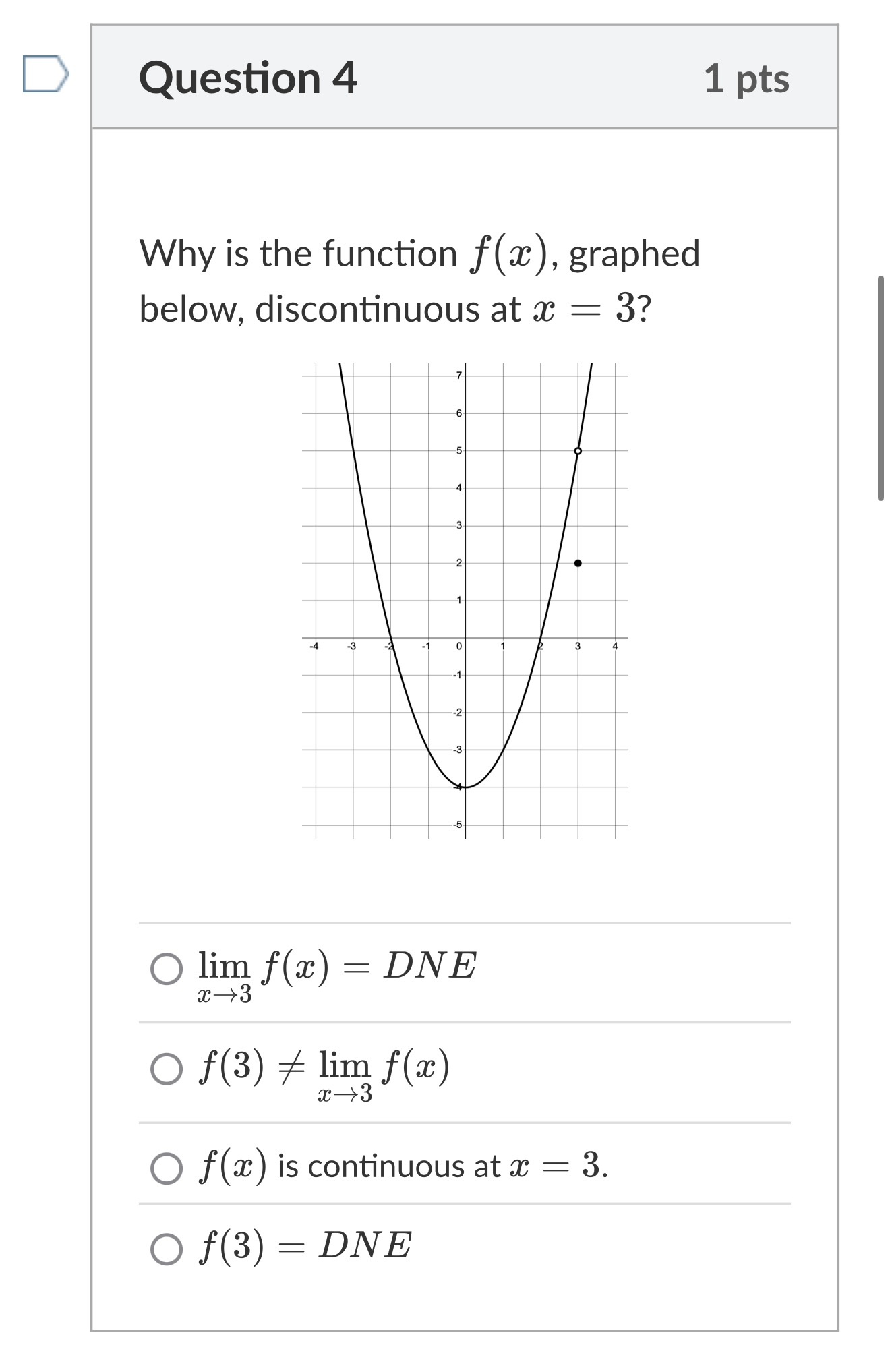
Why is the function $f(x)$, graphed below, discontinuous at $x = 3$?
1 · The intuition
A function is continuous at a point if you can trace the graph through that point without lifting your pen. Discontinuity is wherever the pen has to jump.
There are three reasons a pen might have to jump:
- The function isn't defined there (a hole with no replacement).
- The limit doesn't exist (different approach from left vs. right).
- The function is defined, and the limit does exist, but they're different values (a hole with a single point stuck somewhere else).
Q4 is the third kind — the curve approaches $y = 5$ as $x \to 3$, but the function value at $x = 3$ is $f(3) = 2$. So your pen has to jump from the curve down to the solid dot at $(3, 2)$.
2 · The formal definition
A function $f$ is continuous at $x = a$ if and only if all three of these are true:
| # | Condition | Plain English |
|---|---|---|
| 1 | $f(a)$ is defined | There's a real y-value at $x = a$. |
| 2 | $\displaystyle\lim_{x \to a} f(x)$ exists | The curve approaches a single value as $x$ gets close to $a$. |
| 3 | $f(a) = \displaystyle\lim_{x \to a} f(x)$ | The two values above actually agree. |
If even one fails, $f$ is discontinuous at $a$.
3 · Apply the 3-condition test to Q4
For $f$ at $x = 3$ in the graph above:
| Condition | What the graph shows | Verdict |
|---|---|---|
| 1. $f(3)$ is defined | Solid dot at $(3, 2)$ → $f(3) = 2$ | ✓ Pass |
| 2. $\displaystyle\lim_{x \to 3} f(x)$ exists | Curve approaches the open circle at $(3, 5)$ from both sides | ✓ Pass (limit $= 5$) |
| 3. $f(3) = \displaystyle\lim_{x \to 3} f(x)$ | $2 \neq 5$ | ✗ Fail |
Condition 3 fails, so $f$ is discontinuous at $x = 3$.
Why each wrong answer is wrong:
- Choice 1 — "$\lim_{x \to 3} f(x) = \text{DNE}$": False. The curve clearly approaches $5$ from both sides, so the limit exists and equals $5$.
- Choice 3 — "$f(x)$ is continuous at $x = 3$": False. Continuity test fails on condition 3.
- Choice 4 — "$f(3) = \text{DNE}$": False. $f(3) = 2$ — the solid dot shows the value is defined.
4 · The three types of discontinuity
Discontinuities come in three flavors, classified by which of the three conditions fails:
| Type | Which condition fails | What it looks like | Example |
|---|---|---|---|
| Removable (point) |
Condition 3: $f(a)$ defined, limit exists, but they differ | Hole at one point, plus a dot somewhere else | Our Q4. $f(3) = 2$ but limit $= 5$. |
| Jump | Condition 2: left and right limits exist but are unequal | Curve breaks into two pieces, with a vertical gap between them | Step function, $\lfloor x \rfloor$ at integers |
| Infinite (essential) |
Condition 2: limit is $\pm\infty$ (or undefined) | Vertical asymptote — curve shoots up or down to infinity | $1/x$ at $x = 0$ |
Q4 is the removable kind — the limit exists, you could "fix" the function by just redefining $f(3) = 5$ and the discontinuity would go away. That's why it's called "removable."
5 · The visual language of dots
Two symbols you need to recognize:
- Solid (filled) dot ● — the function is defined at this point, and this is its value.
- Open (hollow) circle ○ — the function is not defined at this point, but the curve approaches this value.
In Q4: the open circle is at $(3, 5)$ — that tells you the limit. The solid dot is at $(3, 2)$ — that tells you $f(3)$. The mismatch is the discontinuity.
Sometimes a problem has only an open circle (no replacement dot) — that means the function isn't even defined at that $x$, which is also a discontinuity, just a different subtype.
6 · Common traps
- "The limit doesn't exist" is the easy wrong answer. If you see a continuous-looking curve with a single moved point, the limit does exist. The issue is the mismatch, not the limit.
- "$f(3)$ doesn't exist" is wrong here too. The solid dot means $f(3) = 2$ — it does exist, just to a different value than the limit.
- Confusing "removable" with "the function isn't defined". Removable means you could remove the discontinuity by changing one value. If the function isn't defined at all there, that's a different (also "removable" in some textbooks) subtype.
- Forgetting to check all 3 conditions. A function can fail more than one (e.g., a jump where the function value is also undefined at the gap).
7 · Check your understanding
For each scenario, identify which condition(s) of the continuity test fail and what type of discontinuity it is:
- $f(x) = \dfrac{1}{x-2}$ at $x = 2$
- $f(x) = \lfloor x \rfloor$ (floor function) at $x = 3$
- $f(x) = \begin{cases} x^2 & x \neq 2 \\ 5 & x = 2 \end{cases}$ at $x = 2$
- $f(x) = \sqrt{x-5}$ at $x = 3$
Show answers
- Infinite discontinuity. $f(2)$ is undefined, limit is $\pm\infty$ (left: $-\infty$, right: $+\infty$). Conditions 1 and 2 both fail.
- Jump discontinuity. $\lim_{x \to 3^-} \lfloor x \rfloor = 2$, $\lim_{x \to 3^+} \lfloor x \rfloor = 3$, so the limit doesn't exist (condition 2 fails). $f(3) = 3$ is defined.
- Removable discontinuity. $\lim_{x \to 2} x^2 = 4$, but $f(2) = 5 \neq 4$. Condition 3 fails. Same flavor as our Q4.
- Continuous (technically). $\sqrt{x-5}$ is defined for $x \geq 5$. At $x = 3$, $f(3)$ isn't real — but on its domain, $f$ is continuous. The continuity definition applies on the domain, not at points outside it. (Subtle point — profs love this.)
8 · What's next
You now have the 3-condition continuity test, the 3 types of discontinuity, and the visual language of open vs. closed circles. This is the toolkit for every "is this continuous?" question. Likely next directions:
- Continuity of composite functions — "If $f$ is continuous and $g$ is continuous, is $f \circ g$ continuous?" (Yes, with caveats.)
- The Intermediate Value Theorem (IVT) — the consequence of continuity you'll use constantly in analysis and proofs
- The Extreme Value Theorem (EVT) — the other big consequence: continuous on a closed interval ⟹ has a max and min
- Limits of the form $0/0$ (factoring) — coming back to techniques after the conceptual detour
Send the next pretest problem, or tell me which topic to drill.