Q14 · Indeterminate limit at a negative root
Same factoring recipe as Q8/Q10, but the bad $x$-value is negative.
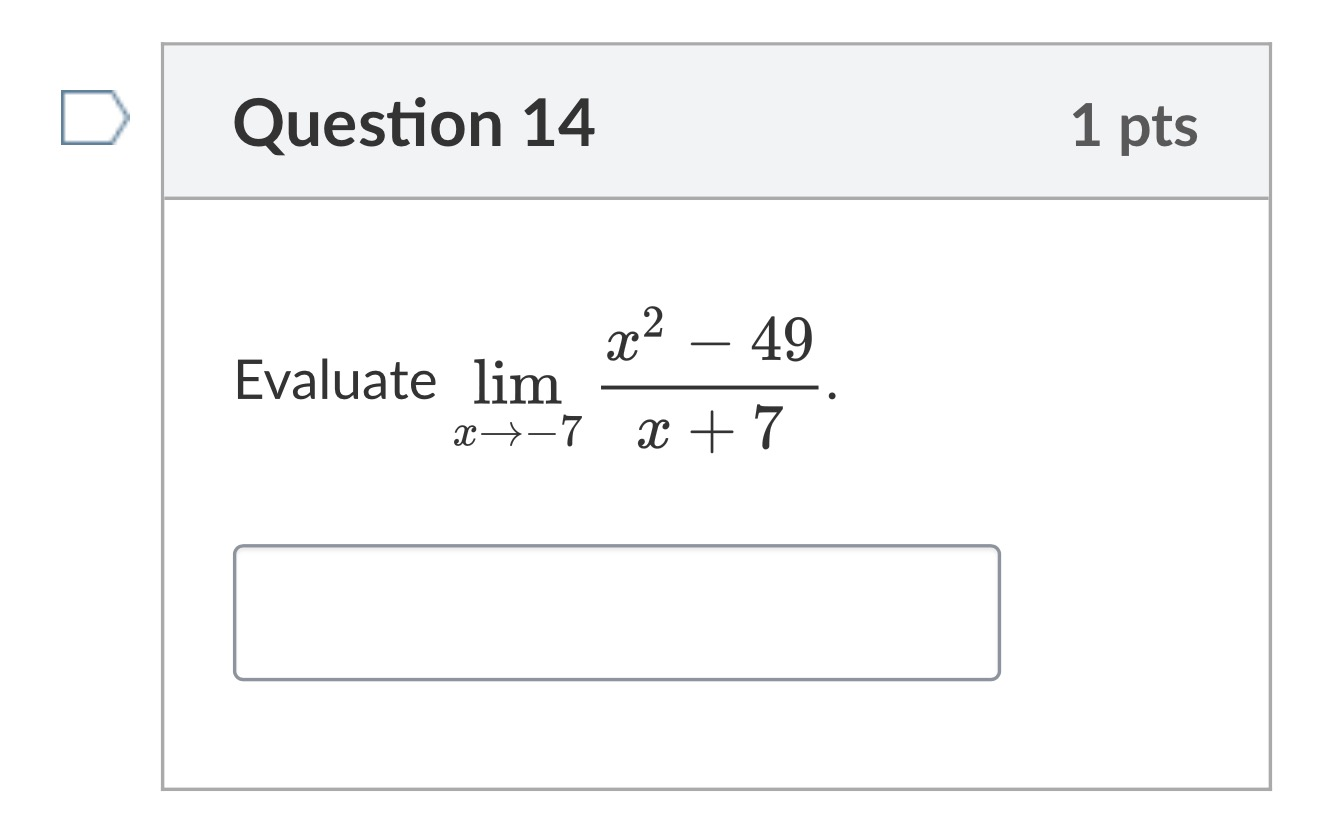
1. Intuition — same shape, different sign
This is structurally the same as Q8 and Q10 — a rational function with a difference of squares in the numerator, a hole at the bad $x$-value, asking for the limit at the hole. The only thing that's changed: the bad $x$-value is $-7$ instead of $5$ or $4$.
"But $x$ is approaching a negative number" doesn't change the technique. The factor-cancel-evaluate recipe works for any hole, positive or negative. The sign just changes which factor of the difference of squares matches the denominator.
🌉 The Q8 ↔ Q10 ↔ Q14 family — same template, three numbers
Three questions, one algebraic template. Each picks a different "bad" $x$-value and asks a slightly different version of the same question.
| Question | Function | Bad $x$ | Asking | Answer |
|---|---|---|---|---|
| Q8 | $\frac{x^2-25}{x-5}$ | $+5$ | What value fills the hole? | $g(5) = 10$ |
| Q10 | $\frac{x^2-16}{x-4}$ | $+4$ | What is the limit at the hole? | limit = 8 |
| Q14 (this one) | $\frac{x^2-49}{x+7}$ | $-7$ | What is the limit at the hole? | limit = $-14$ |
The denominator in Q14 is $(x + 7)$, which equals zero when $x = -7$ (not $x = +7$). That's the only difference: the negative sign on the constant flips which root is "bad." The recipe is the same.
2. Recognize the 0/0 — direct substitution fails
At $x = -7$: numerator is $(-7)^2 - 49 = 49 - 49 = 0$. Denominator is $-7 + 7 = 0$. So we have $\frac{0}{0}$ — the indeterminate form. Just like Q8 and Q10. Plugging in tells you nothing; you have to do work.
3. The fix — factor and cancel
The numerator $x^2 - 49$ is a difference of squares:
$$x^2 - 49 = x^2 - 7^2 = (x-7)(x+7)$$
So the original expression becomes:
$$\frac{x^2 - 49}{x + 7} = \frac{(x-7)(x+7)}{x+7}$$
For $x \neq -7$, the $(x+7)$ factors cancel:
$$= x - 7 \quad \text{(for } x \neq -7\text{)}$$
Notice the structural similarity to Q10: the cancellation is between a factor in the numerator and the entire denominator. In Q10 the denominator was $(x-4)$ and we canceled $(x-4)$ from the numerator. In Q14 the denominator is $(x+7)$ and we cancel $(x+7)$ from the numerator. The only change is the sign.
4. Take the limit — plug in $-7$
For $x \neq -7$ but $x$ close to $-7$, the function equals $x - 7$. As $x \to -7$:
$$\lim_{x \to -7} \frac{x^2 - 49}{x + 7} = \lim_{x \to -7} (x - 7) = -7 - 7 = \boxed{-14}$$
The hole at $x = -7$ sits at height $y = -14$. The function is undefined exactly at $x = -7$, but the limit — the value the function is approaching — is $-14$.
5. Numerical sanity check — values near $-7$
| $x$ | $-7.1$ | $-7.01$ | $-7.001$ | $-6.999$ | $-6.99$ | $-6.9$ |
|---|---|---|---|---|---|---|
| $\frac{x^2-49}{x+7}$ | $-14.1$ | $-14.01$ | $-14.001$ | $-13.999$ | $-13.99$ | $-13.9$ |
As $x$ approaches $-7$ from either side, the function value approaches $-14$. The hole is at $y = -14$, exactly as our algebra says.
6. Why this is the same as Q10 (just with a sign change)
Compare Q10 and Q14 side by side:
| Q10 | Q14 (this one) | |
|---|---|---|
| Function | $\frac{x^2-16}{x-4}$ | $\frac{x^2-49}{x+7}$ |
| Factored numerator | $(x-4)(x+4)$ | $(x-7)(x+7)$ |
| Bad $x$ | $+4$ | $-7$ |
| After cancel | $x + 4$ | $x - 7$ |
| Plug in | $4 + 4 = 8$ | $-7 - 7 = -14$ |
| Answer | 8 | $-14$ |
Same template, same five steps, just with $4 \to 7$ and $x+4 \to x-7$. The arithmetic changes; the recipe doesn't.
7. What about the other root?
The difference of squares $x^2 - 49$ has two roots: $x = +7$ (where $x - 7 = 0$) and $x = -7$ (where $x + 7 = 0$). The denominator in Q14 is $(x+7)$, so the bad root is the negative one. If the question had a denominator of $(x-7)$ instead, the bad root would be $+7$ and the limit would be $7 - (-7) = 14$ (positive, by symmetry).
This is the symmetry of $x^2 - c^2 = (x-c)(x+c)$: the "hole height" is the same on both roots, just with opposite signs. The Q8 hole at $+5$ is at $y = 10$. The "other hole" at $-5$ would also be at $y = -10$. Same shape, mirrored.
8. Common traps
9. Check your understanding
Mini-question. Evaluate $\lim_{x \to -5} \dfrac{x^2 - 25}{x + 5}$.
Show answer
$x^2 - 25 = (x-5)(x+5)$. Cancel: $\frac{(x-5)(x+5)}{x+5} = x - 5$ for $x \neq -5$. Limit as $x \to -5$: $-5 - 5 = -10$.
Same template as Q14, different numbers. Bad root is $-5$ (because of the $x+5$ in the denominator), and after cancellation, $x-5$ at $x = -5$ is $-10$.
10. Practice problems
-
Evaluate $\lim_{x \to -3} \dfrac{x^2 - 9}{x + 3}$.
Show answer
$x^2 - 9 = (x-3)(x+3)$, cancel: $x - 3$ for $x \neq -3$. Limit: $-3 - 3 = -6$. -
Variation. Evaluate $\lim_{x \to 7} \dfrac{x^2 - 49}{x - 7}$. (This is the "mirror" of Q14 — same numerator, different denominator, bad root is $+7$ instead of $-7$.)
Show answer
$x^2 - 49 = (x-7)(x+7)$, cancel: $x + 7$ for $x \neq 7$. Limit: $7 + 7 = 14$. So $\lim_{x \to 7} = 14$.
Compare to Q14: $\lim_{x \to -7} = -14$. Same numerator, opposite bad root, opposite answer. The function is symmetric about the $y$-axis in this case — flipping the sign of $x$ flips the sign of the limit. -
Connection. For the function $g(x) = \frac{x^2 - 49}{x+7}$, what value of $g(-7)$ would make $g$ continuous at $x = -7$? (This is Q14 phrased as a Q8-style continuity question.)
Show answer
Same answer as the limit: $g(-7) = -14$. The limit at the hole is the value that fills it. Q8 and Q14 (and Q10) are the same problem with different framings: the limit at the hole, the value that fills the hole, and the simplified form evaluated at the hole are all the same number.
11. Takeaways
- Difference of squares $a^2 - b^2 = (a-b)(a+b)$ — memorize it, it's the workhorse of these problems.
- The "bad root" is determined by the denominator: $(x+7) = 0$ when $x = -7$, not when $x = 7$. The sign on the constant flips the root.
- The recipe is the same as Q8/Q10: factor, cancel, plug in. Numbers change; the algebra doesn't.
- The "hole height" at a root is the simplified function evaluated there. For $x^2 - c^2$ with denominator $(x - c)$ or $(x + c)$, the height is $\pm 2c$ (positive for the right root, negative for the left root).
- DS connection: the sign-on-the-constant detail is the calculus form of "off-by-one" — easy to flip, hard to spot in code review. Always check which root the denominator is zero at.
© Data Science Tutor · datascience.aidalee.com