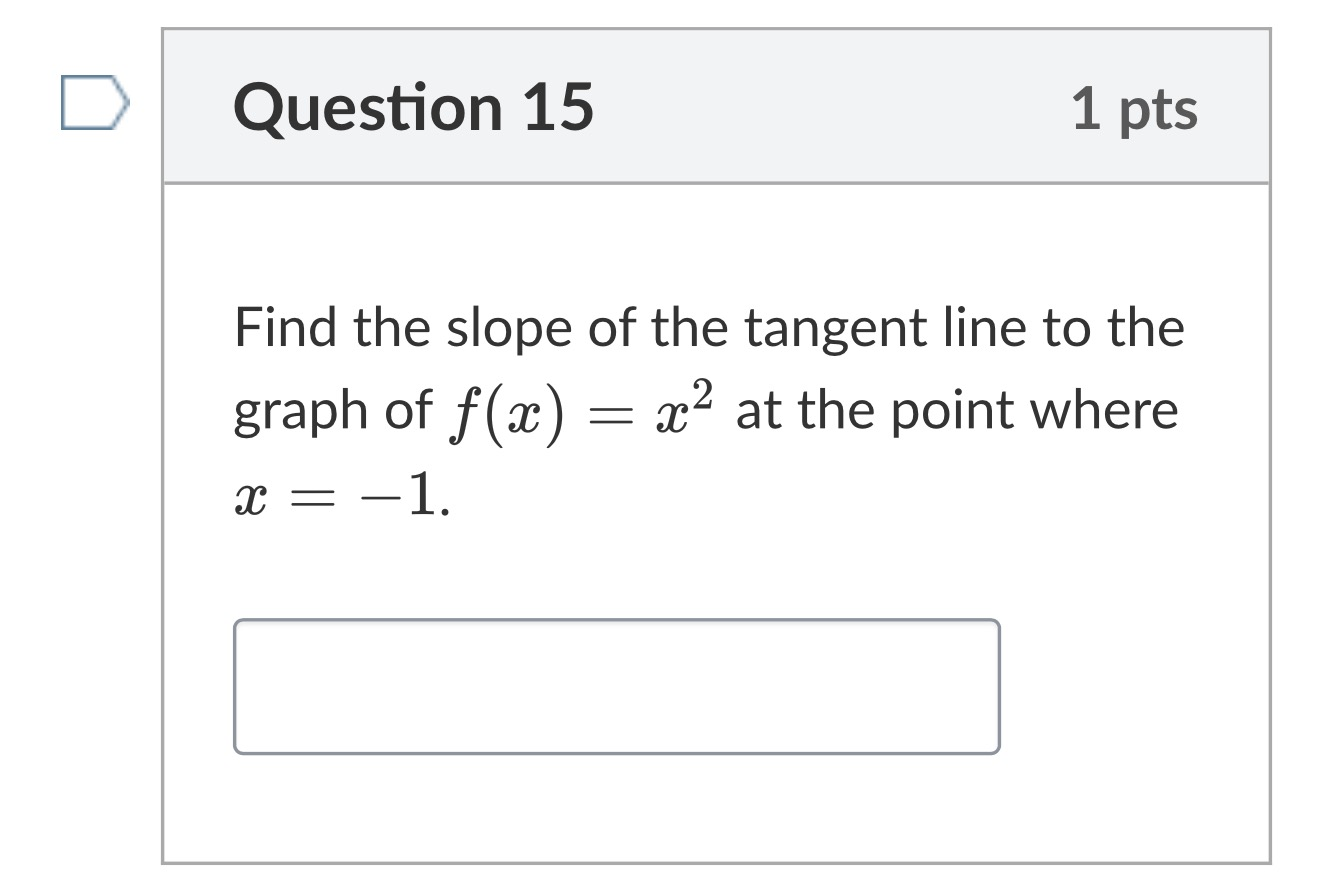
Q15 · Slope of the tangent line
The whole pretest, in one question.
1. Intuition — what is a tangent line?
A tangent line to a curve at a point is the straight line that just "kisses" the curve at that point, with the same slope the curve has at that point. The slope of the tangent line at $x = a$ is the slope the function would have if you zoomed in infinitely close to $x = a$ — the slope of the curve at that instant.
Geometrically, it's the line you'd draw if you placed a ruler against the curve at the point of contact, matching the curve's local direction. The curve and the line agree at the point, and the line's slope equals the curve's slope there.
"Slope of the tangent line" is a fancy way of saying "instantaneous rate of change" — and "instantaneous rate of change" is the **derivative**. So the question is asking: what is $f'(-1)$ for $f(x) = x^2$?
2. The picture — the parabola and the tangent line
At $x = -1$, the function value is $f(-1) = (-1)^2 = 1$. So the point of contact is $(-1, 1)$. The tangent line passes through this point and has slope $f'(-1) = 2(-1) = -2$. So the tangent line equation is:
$$y - 1 = -2(x - (-1)) \quad \Rightarrow \quad y = -2x - 1$$
The diagram below shows the parabola $y = x^2$ (the original curve) and the tangent line at $x = -1$ (the line $y = -2x - 1$). The tangent line touches the parabola at exactly one point and matches its slope there. Notice how the tangent line dips below the parabola to the right of $x = -1$ (where the parabola continues falling) and rises above it to the left of $x = -1$ (where the parabola is also falling but at a different rate, since slope changes constantly on a curve).
Parabola $f(x) = x^2$ (blue) with tangent line at $x = -1$ (orange). The tangent line touches the parabola at $(-1, 1)$ and has slope $-2$.
🌉 The full pretest arc — Q1 through Q15 in one chain
This is where the whole pretest has been heading. Q15 is the destination; everything before was the path.
| Question | Tool | What it measures | Granularity |
|---|---|---|---|
| Q1 | Secant slope | Average rate over an interval | Two specific points on $x^2$ |
| Q6 | Derivative (power rule) | Instantaneous rate at a point | One point on $-2x^2$ |
| Q7 | Secant slope | Average rate over an interval | Two specific points on $-x^3+1$ |
| Q12 | General difference quotient | Secant slope, in general | Symbolic — any $x$, any $h$ |
| Q15 (this one) | Tangent line slope | Instantaneous rate = derivative | One point on $x^2$: $f'(-1)$ |
Q15 = Q6 in disguise. Q6 used the power rule to find $f'(-3)$ for $f(x) = -2x^2$. Q15 finds $f'(-1)$ for $f(x) = x^2$. Same idea, different function, different point. The answer to Q15 is "$f'(-1) = -2$" — exactly the format of a derivative at a point.
3. Three ways to solve Q15
Method 1: power rule (the fast way)
The power rule says: $\frac{d}{dx}(x^n) = nx^{n-1}$. For $f(x) = x^2$, $f'(x) = 2x$. Plug in $x = -1$: $f'(-1) = 2(-1) = -2$.
This is the same approach Q6 used. Two steps, one calculation, one answer. **Answer: −2.**
Method 2: definition of the derivative (the long way)
The derivative is the limit of the difference quotient. So:
$$f'(-1) = \lim_{h \to 0} \frac{f(-1+h) - f(-1)}{h}$$
Compute $f(-1+h) = (-1+h)^2 = 1 - 2h + h^2$. And $f(-1) = 1$. So:
$$f'(-1) = \lim_{h \to 0} \frac{(1 - 2h + h^2) - 1}{h} = \lim_{h \to 0} \frac{-2h + h^2}{h} = \lim_{h \to 0}(-2 + h) = -2$$
Same answer: $-2$. The power rule is just this calculation, done once for all $x$.
Method 3: numerical — values near $x = -1$
A good sanity check: compute the secant slope from $(-1, f(-1))$ to a nearby point, with $h$ getting smaller and smaller. The slopes should approach $-2$.
| $h$ | point | secant slope |
|---|---|---|
| $1$ | $(0, 0)$ | $-1$ |
| $0.5$ | $(-0.5, 0.25)$ | $-1.5$ |
| $0.1$ | $(-0.9, 0.81)$ | $-1.9$ |
| $0.01$ | $(-0.99, 0.9801)$ | $-1.99$ |
| $h \to 0$ | $(-1, 1)$ | $\to -2$ |
The secant slopes get closer and closer to $-2$ as the second point gets closer to $(-1, 1)$. The tangent line slope is exactly $-2$ — the value these secant slopes are converging to. This is the geometric meaning of the derivative.
4. Why all three methods give the same answer
This is the structural fact of differential calculus: the power rule, the difference quotient limit, and the geometric "slope of the tangent line" are three faces of the same idea. Once you know one, you know all three.
For Q15:
- Power rule: $f'(x) = 2x$, so $f'(-1) = -2$. (Q6's tool, applied to Q15's function.)
- Difference quotient limit: $\lim_{h \to 0} \frac{f(-1+h) - f(-1)}{h} = -2$. (Q12's tool, evaluated at $x = -1$.)
- Geometric tangent line: the parabola at $(-1, 1)$ is sloping downward at $-2$ units of $y$ per unit of $x$. (Q15's framing.)
5. Common traps
6. Check your understanding
Mini-question. What is the slope of the tangent line to $f(x) = x^2$ at $x = 3$?
Show answer
$f'(x) = 2x$, so $f'(3) = 6$.
The tangent line at $x = 3$ has slope $6$ (the parabola is rising steeply there) and passes through $(3, 9)$. The tangent line equation: $y - 9 = 6(x - 3)$, or $y = 6x - 9$.
7. Practice problems
-
Find the slope of the tangent line to $g(x) = 3x^2$ at $x = 2$.
Show answer
$g'(x) = 6x$, so $g'(2) = 12$. Slope is $12$. Tangent line: $y - 12 = 12(x - 2)$, or $y = 12x - 12$. (The function value is $g(2) = 12$, so the line passes through $(2, 12)$ with slope $12$.) -
Sign intuition. For $f(x) = x^2$, the slope of the tangent line is positive for $x > 0$, zero at $x = 0$, and negative for $x < 0$. Explain why in plain English.
Show answer
The parabola opens upward. To the right of the vertex (where $x > 0$), the curve is rising — slopes are positive. To the left of the vertex (where $x < 0$), the curve is falling as $x$ increases — slopes are negative. At the vertex ($x = 0$), the curve is momentarily flat — slope is $0$. The tangent line at the vertex is horizontal. -
Q6 connection. In Q6, $f(x) = -2x^2$ and the question was $f'(-3) = ?$. The slope of the tangent line at $x = -3$ for this downward parabola is $f'(-3) = -4(-3) = 12$. Why is this positive when Q15's slope (also for $x^2$ at a negative $x$) was negative?
Show answer
Q6 has $f(x) = -2x^2$ (note the leading minus sign — a downward parabola). Q15 has $f(x) = x^2$ (upward). For a downward parabola, the curve is falling on the right (negative slope) and rising on the left (positive slope) — opposite of the upward parabola. So the sign of the slope at a negative $x$ is flipped between the two functions. The derivative is the same formula structure, just with the sign on the constant flipped.
8. Takeaways
- Slope of the tangent line at a point = the derivative at that point = the instantaneous rate of change at that point. All three are the same number.
- For Q15: $f(x) = x^2$, so $f'(x) = 2x$, so $f'(-1) = -2$. Done in three lines.
- The pretest arc: Q1 (secant slope) → Q6 (derivative, power rule) → Q7 (secant slope, harder function) → Q12 (general difference quotient) → Q15 (tangent line slope = derivative at a point). Same idea, increasing generality and power.
- Three methods, one answer: power rule (fast), difference quotient limit (rigorous), numerical secant slopes (intuitive). All three give $-2$ for Q15.
- DS connection: tangent line slope is the atomic unit of how ML models learn. Every gradient, every marginal effect, every "rate of change" question in ML is a tangent line slope question.
© Data Science Tutor · datascience.aidalee.com