Q13 · The trio of discontinuities, all in one graph
The capstone: spot hole, jump, and vertical asymptote in a single picture.
1. Intuition — the cumulative test
This is the question that ties the whole pretest together. We've now seen three flavors of discontinuity in isolation (Q4, Q5, Q8, Q9, Q11) — and Q13 puts all three in a single graph. The test is whether you can identify each one on sight, by reading the visual signature.
The matching format is also a tell: the answer choices for each location come from the same set of three types. So the test is partly whether you can identify each location, and partly whether you can keep the three categories straight.
🌉 The full pretest discontinuity arc — now complete
The discontinuity thread started at Q4 (the 3-condition continuity test) and ran through Q5, Q8, Q9, Q11, and now Q13. Each question added one new flavor or perspective. Q13 is where they all come together.
- Q4: the 3-condition test for continuity at a point
- Q5: one-sided limits from a graph (jump)
- Q8: hole (removable) discontinuity — fill it in
- Q9: one-sided limits from a formula (jump)
- Q11: vertical asymptote — curve shoots to $\pm\infty$
- Q13 (this one): identify all three in one graph
2. The three flavors — visual signatures
Hole (removable discontinuity): open circle on an otherwise continuous curve
The curve passes through the point, but with an open circle. From the left and the right, the function approaches the same value — the limit exists. The only issue is that the function value at that point doesn't match (or isn't defined). Same shape as Q8 and Q10 — the "removable" we called it then is called a "hole" here.
Look for: an open circle on a curve that would otherwise be smooth through that point.
Jump: closed circle on one piece, open circle on the next, with different y-values
Two pieces of the function meet at the same $x$ but different $y$ values. The left limit and right limit both exist (finite numbers) but don't agree. There's no single value you can plug in to "fix" it.
Look for: a closed circle at one height, an open circle at a different height, both at the same $x$.
Vertical asymptote (infinite discontinuity): curve shoots off to $\pm\infty$
The function grows without bound as $x$ approaches the asymptote from either side. The graph dives off the bottom of the screen or shoots off the top. Same shape as Q11.
Look for: a curve that disappears off the top or bottom of the visible region, with the line $x = a$ being a vertical line the curve never touches.
Horizontal asymptote: a different concept (the distractor)
A horizontal asymptote is a horizontal line that the curve approaches as $x \to +\infty$ or $x \to -\infty$. It describes long-run behavior at the far ends of the graph, not a discontinuity at a single point. The right branch in Q13's graph appears to approach the $x$-axis as $x$ grows — that's a horizontal asymptote at $y = 0$ for the right piece, but it's not a "discontinuity type" in the matching list. It's a distractor.
Distinguishing trick: discontinuities happen at a specific $x$ value. Horizontal asymptotes describe behavior at the ends of the graph, not at a point.
3. The trio in this graph — labeled
| Location | Type | Visual signature | Why |
|---|---|---|---|
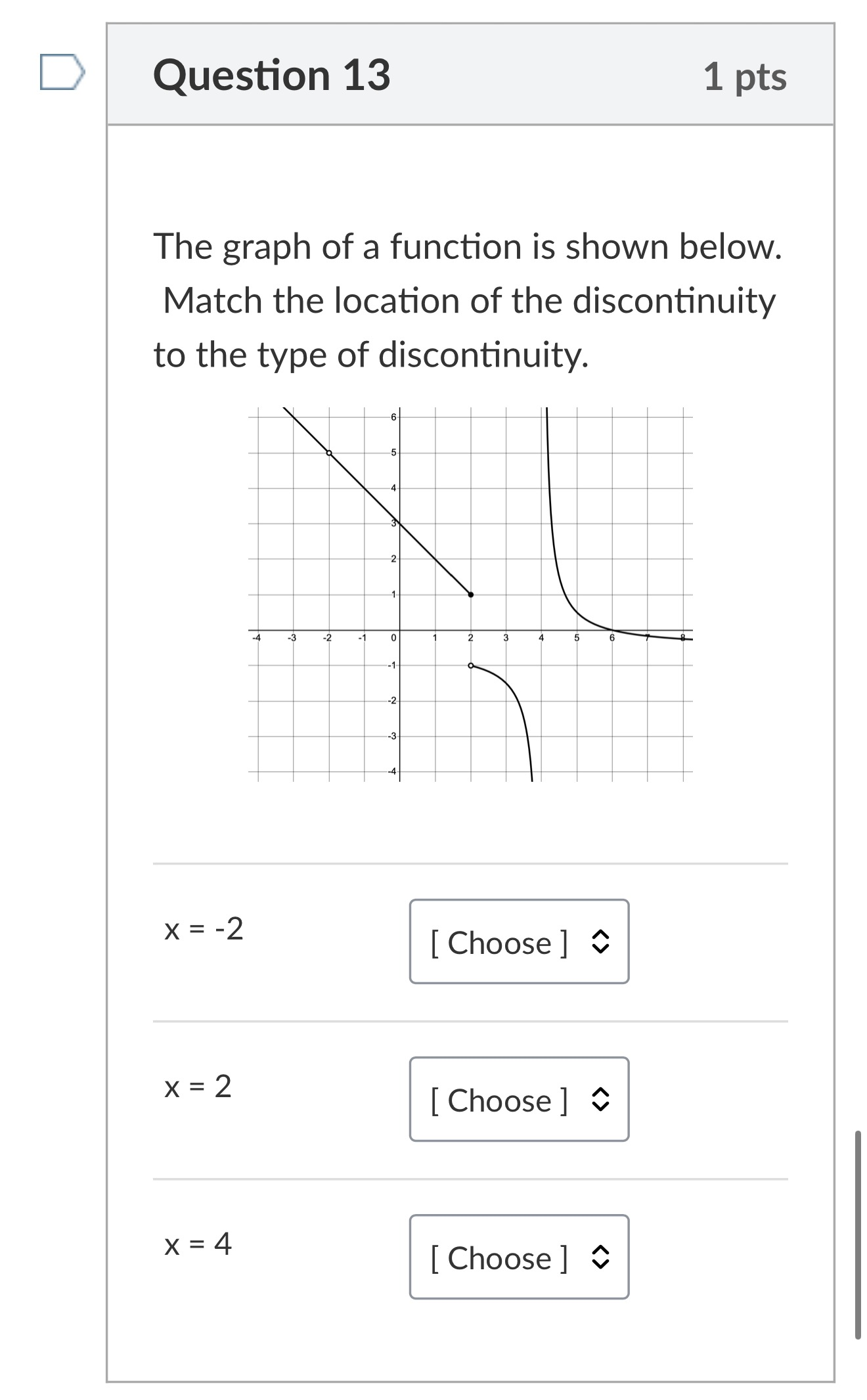
| x = −2 | Hole (removable) | Open circle on the line $y = -x + 3$ at $(-2, 5)$ | Left limit: $\lim_{x \to -2^-} f(x) = 5$. Right limit: $\lim_{x \to -2^+} f(x) = 5$. Both equal 5. But $f(-2) \neq 5$ (or is undefined). The limit exists; the function value doesn't match. Hole. Fixable: $f(-2) = 5$. |
| x = 2 | Jump | Closed circle at $(2, 1)$, open circle at $(2, -1)$ | Left limit: $\lim_{x \to 2^-} f(x) = 1$ (line approaches 1). Right limit: $\lim_{x \to 2^+} f(x) = -1$ (curve starts at -1). The two one-sided limits disagree on value, so the two-sided limit DNE. Not fixable. |
| x = 4 | Vertical asymptote (infinite) | Vertical asymptote at $x = 4$; curve dives to $-\infty$ on left, shoots to $+\infty$ on right | As $x \to 4^-$, the middle curve plunges to $-\infty$. As $x \to 4^+$, the right curve shoots to $+\infty$. Function grows without bound. Same pattern as Q11. |
4. The decision tree — how to read any discontinuity question
When you see a graph with a potential discontinuity, run this checklist:
- Open circle only: the function is undefined there. Could be removable or jump.
- Closed circle: the function is defined there. Compare to the limit from each side.
- Nothing visible: the curve is continuous through this point (or the discontinuity is off-screen).
- Both limits exist and agree (finite number) → could be removable or fully continuous.
- Both limits exist but disagree (different finite numbers) → jump.
- One or both limits are $\pm \infty$ → infinite (asymptote).
- $f(a)$ matches $\lim_{x \to a} f(x)$ → continuous (no discontinuity here).
- $f(a)$ doesn't match (or isn't defined), but the limit exists → removable.
- The two-sided limit doesn't exist at all → jump or infinite.
5. Worked analysis — each location in detail
At x = −2: why hole?
The line $y = -x + 3$ passes smoothly through $(-2, 5)$. The function value at $x = -2$ is "missing" (open circle), but the line on either side is approaching $y = 5$ from both directions.
$$\lim_{x \to -2^-} f(x) = 5, \quad \lim_{x \to -2^+} f(x) = 5, \quad \lim_{x \to -2} f(x) = 5 \text{ (limit exists)}$$
The function value is undefined or doesn't equal 5. So the limit exists and is finite, but the function doesn't match. That's the textbook definition of a removable discontinuity. If you "filled in" $f(-2) = 5$, the function would be continuous.
At x = 2: why jump?
Two different pieces of the function meet at $x = 2$, but at different heights. The line piece ends with a closed circle at $(2, 1)$ — so $f(2) = 1$. The curve piece begins with an open circle at $(2, -1)$ — so the function does not take the value $-1$ at $x = 2$.
$$\lim_{x \to 2^-} f(x) = 1, \quad \lim_{x \to 2^+} f(x) = -1, \quad \lim_{x \to 2} f(x) \text{ DNE}$$
The two one-sided limits are finite but unequal. That's the textbook definition of a jump discontinuity. No single value of $f(2)$ could possibly make the two sides agree, because the issue isn't the value — it's the shape. The function literally jumps from $y = 1$ to $y = -1$ as $x$ crosses 2.
Note: $f(2) = 1$ (the closed circle is on the line piece). The function is "continuous from the left" at $x = 2$ — the left limit equals $f(2)$ — but discontinuous from the right.
At x = 4: why vertical asymptote?
The middle curve plunges off the bottom of the visible graph as $x \to 4^-$. The right curve shoots off the top as $x \to 4^+$. The function is undefined at $x = 4$ (asymptote), and the function values grow without bound as $x$ approaches 4 from either side.
$$\lim_{x \to 4^-} f(x) = -\infty, \quad \lim_{x \to 4^+} f(x) = +\infty, \quad \lim_{x \to 4} f(x) \text{ DNE}$$
Same pattern as Q11. The function has a vertical asymptote at $x = 4$, and the one-sided limits are unbounded. That's the textbook definition of an infinite discontinuity. There's no value to "fill in" — the function genuinely grows without bound near $x = 4$.
6. Common traps
- Hole (removable) is "missing data you can fill in" — NaN handling, interpolation,
fillna(limit)in pandas. - Jump is "the model changes behavior at a threshold" — decision tree splits, ReLU activation, piecewise-defined policies, hysteresis.
- Vertical asymptote (infinite) is "the model blows up near a value" — division by near-zero, log of near-zero, the kind of thing that returns
inforNaNin your code.
7. Check your understanding
Mini-question. Suppose a function $g$ has, at $x = 3$: a closed circle at $(3, 4)$, an open circle at $(3, 4)$, and the function is defined as $g(3) = 4$. Is the function continuous at $x = 3$?
Show answer
This is a trick question — the closed circle at $(3, 4)$ and the open circle at $(3, 4)$ are the same point. That means the function is "trying" to do two contradictory things at $x = 3$: be defined (closed) and not be defined (open). If both circles are at the same $y$ value and the function equals that value, then the curve is continuous — no discontinuity at all. The open circle is just a notational artifact.
The three-condition test: $g(3) = 4$ (defined ✓), $\lim_{x \to 3} g(x) = 4$ (limit exists ✓), $g(3) = \lim_{x \to 3} g(x)$ (match ✓). All three hold, so $g$ is continuous at $x = 3$.
8. Practice problems
-
From a graph. A function has a closed circle at $(2, 5)$, an open circle at $(2, 5)$ on the same piece, and the function continues smoothly through that point. What type of discontinuity is at $x = 2$?
Show answer
None! The closed and open circles are at the same point, the function matches, the curve is smooth. The function is continuous at $x = 2$. The open circle is redundant or a notational slip. -
From a formula. For $h(x) = \begin{cases} x^2, & x < 1 \\ 5, & x = 1 \\ 2x, & x > 1 \end{cases}$, what type of discontinuity is at $x = 1$?
Show answer
Left limit: $\lim_{x \to 1^-} h(x) = 1$. Right limit: $\lim_{x \to 1^+} h(x) = 2$. They disagree, so it's a jump. The closed-circle value $h(1) = 5$ is also discontinuous from both sides, but the main issue is the jump from 1 to 2. (If you wanted a fully continuous version, you'd redefine $h(1) = 1$ or $h(1) = 2$ — but you can't make the left and right limits agree without a different function.) -
Connection. For $g(x) = \frac{x-2}{x-2}$ (defined for $x \neq 2$), what type of discontinuity is at $x = 2$? How is this the same and different from Q13's $x = -2$ case?
Show answer
Hole (removable). For $x \neq 2$, $g(x) = 1$. The limit as $x \to 2$ is 1, but the function is undefined at $x = 2$. Fill in $g(2) = 1$ and you have a continuous function. Same as Q13's $x = -2$: open circle on a curve that would otherwise be smooth, limit exists, function value doesn't match. Q13's $x = -2$ is a "hole at height 5"; this one is a "hole at height 1". Different numbers, same structure.
9. Takeaways
- Three flavors, three signatures: hole = open circle on a smooth curve; jump = closed + open circles at different heights; vertical asymptote = curve disappears off the screen as $x \to a$.
- Decision tree: check the function value (open/closed circle?) → check left and right limits (finite and equal? finite but unequal? $\pm \infty$?) → name the discontinuity.
- Distinguishing the distractor: "horizontal asymptote" describes long-run behavior as $x \to \pm\infty$ (a horizontal line the curve approaches), not a discontinuity at a specific $x$. Discontinuities always live at a specific $x$ value.
- The full pretest discontinuity arc ran Q4 → Q5 → Q8 → Q9 → Q11 → Q13. Q13 is the synthesis: all three flavors in one graph, and you identify each by visual signature.
- DS connection: each flavor has its own fix in code —
fillnafor hole, threshold logic for jump, near-zero guards for vertical asymptote. Q13's three locations, three different cures.
© Data Science Tutor · datascience.aidalee.com