Q12 · General difference quotient
The definition of the derivative, written out in full.
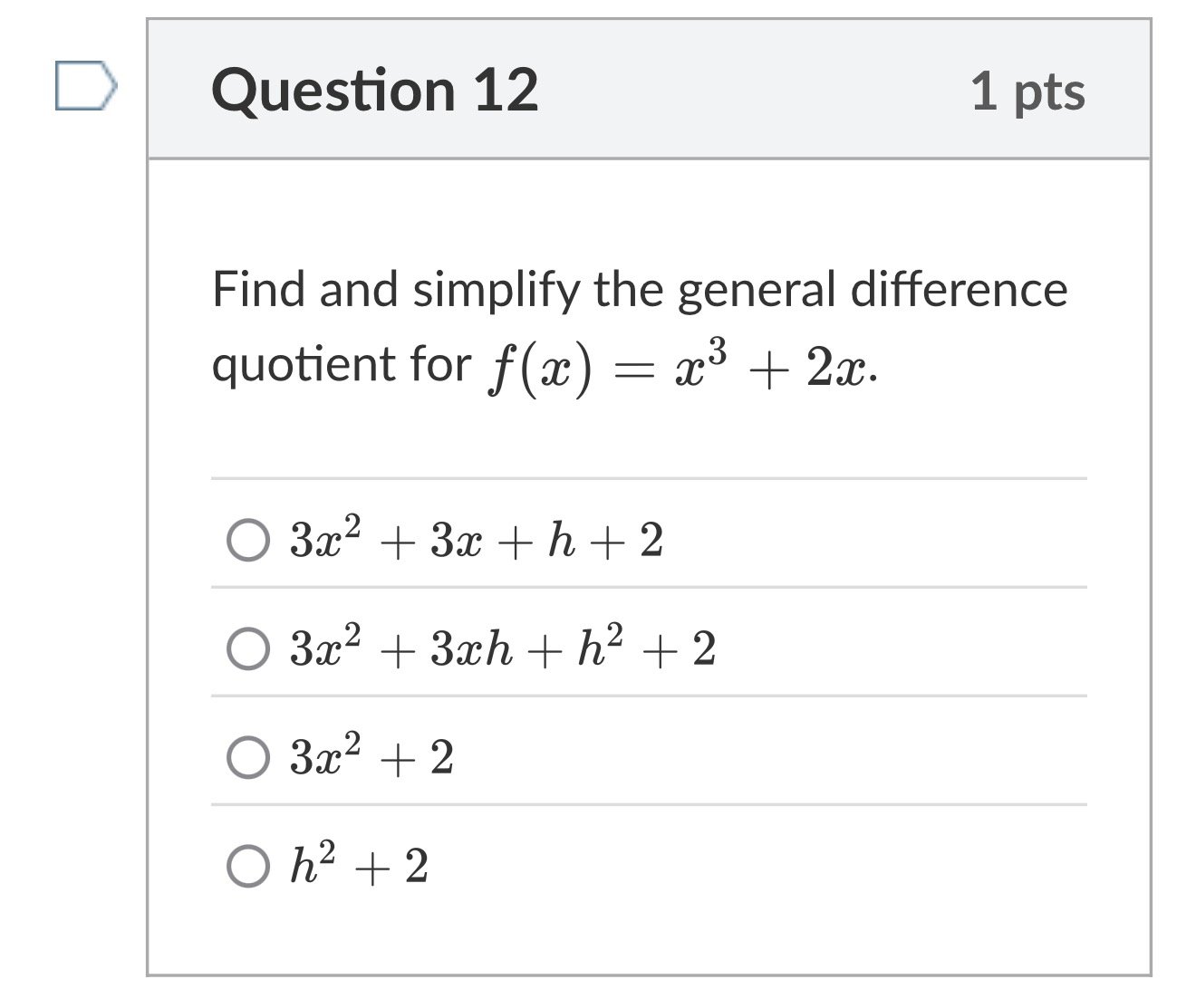
1. Intuition — what is the "general difference quotient"?
The difference quotient is the formula for the secant slope of a function between two points, in full generality. The formula you've seen since Q1:
$$\frac{f(b) - f(a)}{b - a}$$
The "general" version uses letters instead of specific numbers: it asks the question, "for an arbitrary starting point $x$ and a step $h$, what's the slope of the secant from $(x, f(x))$ to $(x+h, f(x+h))$?"
$$\frac{f(x+h) - f(x)}{(x+h) - x} = \frac{f(x+h) - f(x)}{h}$$
The denominator simplifies to $h$ because the two points are $h$ apart. The whole thing is a formula in two variables: $x$ (where you start) and $h$ (how far you step). It's the slope of the secant line in general — pick any $x$ and any $h$, this formula gives you the slope.
🌉 The Q1 ↔ Q7 ↔ Q12 ↔ Q6 chain — the heart of calculus
Q1, Q7, and Q12 are the same question with increasing generality. Q6 is what you get by taking the limit.
| Question | Function | Formula | Granularity |
|---|---|---|---|
| Q1 | $f(x) = x^2$ | $\frac{f(3) - f(-1)}{3 - (-1)} = \frac{9 - 1}{4} = 2$ | One specific interval, one specific function |
| Q7 | $g(x) = -x^3 + 1$ | $\frac{g(2) - g(-1)}{2 - (-1)} = -3$ | One specific interval, harder function |
| Q12 (this one) | $f(x) = x^3 + 2x$ | $\frac{f(x+h) - f(x)}{h}$ in closed form | Any interval, any function — symbolic answer |
| Q6 (the limit) | any $f$ | $f'(a) = \lim_{h \to 0} \frac{f(a+h) - f(a)}{h}$ | Two points collide → instantaneous rate |
Master Q12 and you've mastered the heart of differential calculus. Take $\lim_{h \to 0}$ of Q12's answer and you have the derivative definition. Take Q6's $f'(-3)$ with a specific $f$ and you have what Q12 would have given you in the limit.
2. The recipe — five steps, every time
- Compute $f(x+h)$ by substituting $x+h$ for every $x$ in the formula.
- Expand everything — no shortcuts, expand each $(x+h)^n$ via the binomial theorem.
- Subtract $f(x)$.
- Factor out $h$ from the numerator (this is the only "trick").
- Cancel $h$ against the denominator $h$.
The recipe is mechanical. The only thing you have to know cold is the binomial theorem for $(x+h)^n$ — and for this problem, $n = 3$ and $n = 1$ only.
3. Worked solution — step by step
Step 1: Compute $f(x+h)$
Replace every $x$ in $f(x) = x^3 + 2x$ with $(x+h)$:
$$f(x+h) = (x+h)^3 + 2(x+h)$$
Step 2: Expand
$(x+h)^3 = x^3 + 3x^2h + 3xh^2 + h^3$ (binomial theorem)
$2(x+h) = 2x + 2h$
So $f(x+h) = x^3 + 3x^2h + 3xh^2 + h^3 + 2x + 2h$
Step 3: Subtract $f(x)$
$$f(x+h) - f(x) = \left(x^3 + 3x^2h + 3xh^2 + h^3 + 2x + 2h\right) - \left(x^3 + 2x\right)$$
The $x^3$ cancels. The $2x$ cancels. What's left:
$$= 3x^2h + 3xh^2 + h^3 + 2h$$
Step 4: Factor out $h$
Every term has at least one $h$ in it (this is by design — that's why the formula is structured the way it is):
$$= h\left(3x^2 + 3xh + h^2 + 2\right)$$
Step 5: Cancel $h$ against the denominator
$$\frac{f(x+h) - f(x)}{h} = \frac{h\left(3x^2 + 3xh + h^2 + 2\right)}{h} = 3x^2 + 3xh + h^2 + 2$$
4. The answer
$$\boxed{\frac{f(x+h) - f(x)}{h} = 3x^2 + 3xh + h^2 + 2}$$
This is option 2. It's a function of both $x$ (where you started) and $h$ (how far you stepped). Plug in any specific $x$ and $h$ to get the slope of the secant line between $(x, f(x))$ and $(x+h, f(x+h))$.
5. Sanity check — does it match Q1 and Q7?
The general difference quotient for $f(x) = x^2$ is $\frac{(x+h)^2 - x^2}{h} = \frac{2xh + h^2}{h} = 2x + h$. Plug in $x = -1$ and $h = 4$ (to get from $-1$ to $3$): $2(-1) + 4 = 2$. That matches Q1's answer. ✓
For $f(x) = x^2$ the secant slope at $x = -1$ over a step of $h = 4$ is $2$. The recipe generalizes.
6. The Q6 connection — the limit is the derivative
The derivative of $f$ at $x$ is defined as:
$$f'(x) = \lim_{h \to 0} \frac{f(x+h) - f(x)}{h}$$
So the derivative is the limit of Q12's answer as $h \to 0$. Let's take it:
$$f'(x) = \lim_{h \to 0} \left(3x^2 + 3xh + h^2 + 2\right) = 3x^2 + 3x \cdot 0 + 0^2 + 2 = 3x^2 + 2$$
And that matches the power rule: $\frac{d}{dx}(x^3 + 2x) = 3x^2 + 2$. ✓
This is the proof of the power rule for the $x^3 + 2x$ case. The same procedure proves the power rule for $x^n$ in general. The reason the power rule works is that the limit of the difference quotient always collapses the $h$-dependent terms to zero.
7. Why the other three options are traps
| Option | Answer | What went wrong |
|---|---|---|
| 1 | $3x^2 + 3x + h + 2$ | Forgot to expand $(x+h)^2$ correctly — kept $3x$ instead of $3xh$ for the middle term. |
| 2 ✓ | $3x^2 + 3xh + h^2 + 2$ | The correct answer. Notice $3xh$ and $h^2$ — the $h$-dependent terms that vanish in the limit. |
| 3 | $3x^2 + 2$ | This is the derivative, not the difference quotient. Took the limit too early. |
| 4 | $h^2 + 2$ | Only kept the highest-order $h$ term from the numerator. Lost the $3x^2h$ and $3xh^2$ terms. |
8. Common traps
9. Check your understanding
Mini-question. Find and simplify the general difference quotient for $g(x) = x^2 + 5$.
Show answer
$g(x+h) = (x+h)^2 + 5 = x^2 + 2xh + h^2 + 5$.
$g(x+h) - g(x) = 2xh + h^2 = h(2x + h)$.
$\frac{g(x+h) - g(x)}{h} = 2x + h$.
Note: no $h^2$ term in the simplified answer (it got absorbed). The derivative $\lim_{h \to 0} = 2x$ — matches the power rule.
10. Practice problems
-
Find the general difference quotient for $f(x) = 4x^2 - 3x$.
Show answer
$f(x+h) = 4(x+h)^2 - 3(x+h) = 4x^2 + 8xh + 4h^2 - 3x - 3h$.
$f(x+h) - f(x) = 8xh + 4h^2 - 3h = h(8x + 4h - 3)$.
Difference quotient: $8x + 4h - 3$.
Derivative (limit): $8x - 3$ — matches the power rule. -
Conceptual. Why does every term in the difference quotient numerator have an $h$ in it? (Hint: think about what $f(x+h) - f(x)$ means geometrically.)
Show answer
$f(x+h) - f(x)$ is the change in $f$ as $x$ changes by $h$. As $h \to 0$, the change shrinks toward 0 (assuming $f$ is continuous). So the numerator is "small" — it scales with $h$ in some sense. The denominator is exactly $h$. The ratio is a finite slope, but each individual piece of the numerator is proportional to $h$. The factoring-out step is exactly the algebraic reflection of this geometric fact. -
Connection to Q6. The difference quotient for $f(x) = -2x^2$ (Q6's function) is $\frac{f(x+h) - f(x)}{h} = -4x - 2h$. Verify by taking the limit as $h \to 0$ that this gives Q6's answer.
Show answer
$\lim_{h \to 0}(-4x - 2h) = -4x$. At $x = -3$: $-4(-3) = 12$. That matches Q6's $f'(-3) = 12$. ✓
11. Takeaways
- The general difference quotient $\frac{f(x+h) - f(x)}{h}$ is the slope of the secant line between $(x, f(x))$ and $(x+h, f(x+h))$, for arbitrary $x$ and $h$.
- Recipe: compute $f(x+h)$, expand, subtract $f(x)$, factor out $h$, cancel. Five mechanical steps.
- The difference quotient is a function of two variables ($x$ and $h$), not one. The derivative is what you get by taking $\lim_{h \to 0}$.
- The reason the power rule works is that the $h$-dependent terms in the difference quotient always vanish in the limit, leaving just the power-rule answer.
- Q1, Q7, Q12, and Q6 are the same underlying question — secant slope, in different disguises. Master this chain and you've mastered the foundation of differential calculus.
- DS connection: the difference quotient is the engine of gradient descent, backprop, numerical differentiation, and finite differences. Not a calc I exercise — the foundation of how ML models learn.
© Data Science Tutor · datascience.aidalee.com