Q11 · One-sided limit at a vertical asymptote
The function shoots off to infinity. Read which way.
1. Intuition — what is the question asking?
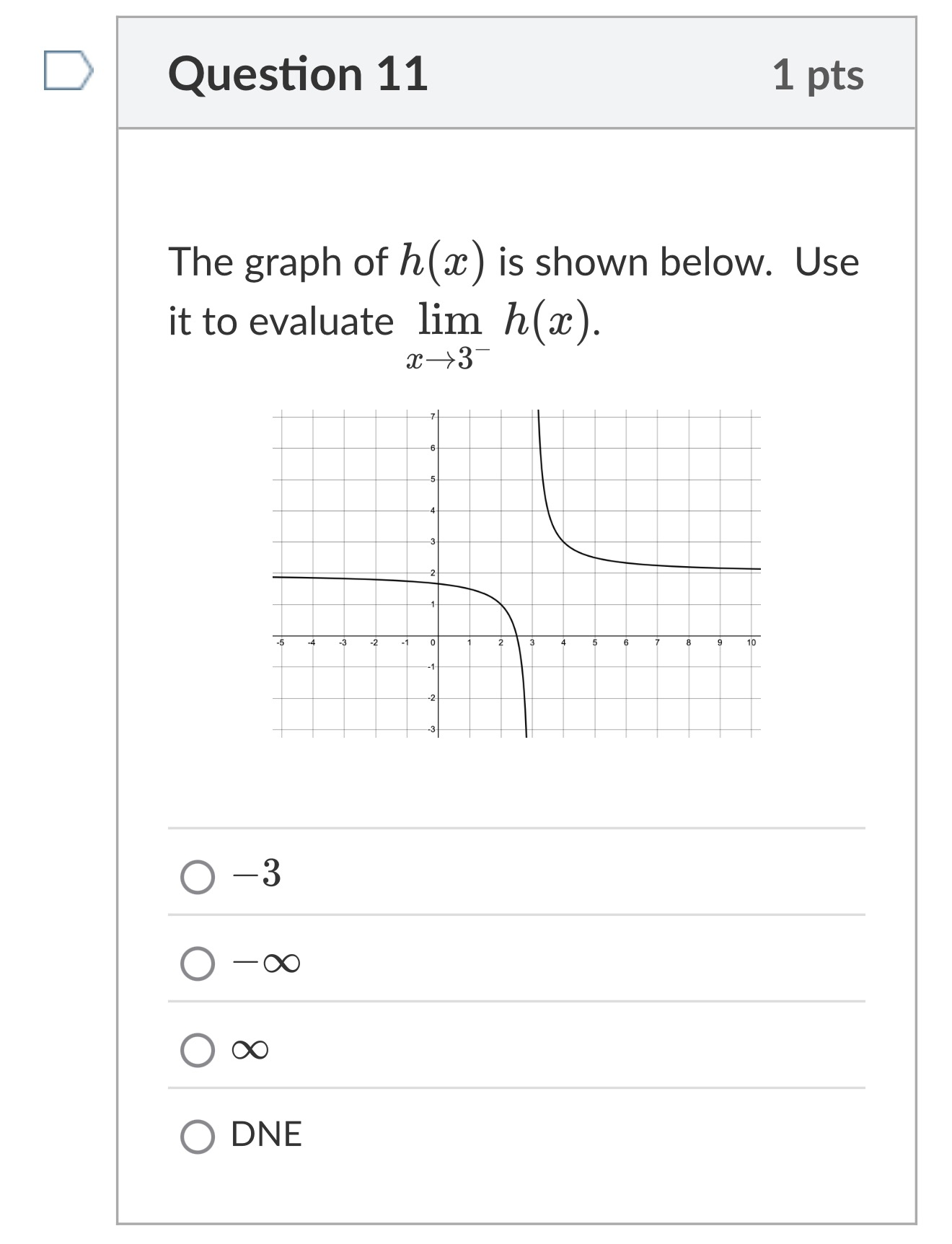
We're given a graph and asked to read off $\lim_{x \to 3^-} h(x)$ — the value $h(x)$ approaches as $x$ gets close to 3 from the left side (from values less than 3).
The graph shows a vertical asymptote at $x = 3$: the function is defined on both sides of 3, but at $x = 3$ itself the function is undefined (the curve "blows up"). A vertical asymptote is a vertical line that the curve approaches but never touches, and getting close to it usually means the function is shooting off to $\pm \infty$.
The minus sign in $3^-$ tells us we approach 3 from the left. So we look at the left branch of the graph and ask: as $x$ goes from far left toward 3, what $y$-value does the curve head toward?
🌉 The three flavors of discontinuity — completed
We've now seen all three. Q11 is the capstone: infinite discontinuity, the most dramatic of the three.
| Flavor | Question | Limit | Can we fix it? |
|---|---|---|---|
| Removable (hole) | Q8, Q10 | Exists and is finite | ✅ Plug in one value |
| Jump | Q5, Q9 | One-sided limits differ — full limit DNE | ❌ No single value can fix it |
| Infinite (asymptote) | Q11 (this one) | $\pm \infty$ (or DNE if both sides disagree on the sign) | ❌ Function grows without bound |
2. Read the graph — what is each branch doing?
- At $x = -5$: $y \approx 2$ (sitting on the horizontal asymptote)
- From $x = -5$ to $x \approx 1$: nearly flat, $y$ just under 2
- From $x \approx 1$ to $x = 3$: curve plunges downward
- At $x = 3^-$: $y \to -\infty$ (off the bottom of the graph)
- At $x = 3^+$: $y \to +\infty$ (off the top of the graph)
- From $x \approx 4$ to $x = 10$: curve decreases rapidly, then levels off
- At $x = 10$: $y \approx 2$ (approaching the horizontal asymptote from above)
The two branches mirror each other across the asymptote in a "flip" pattern: left goes to $-\infty$ as $x \to 3^-$, right comes from $+\infty$ as $x \to 3^+$. This is the signature of a rational function with $(x-3)$ in the denominator, like $h(x) = \dfrac{1}{x-3} + 2$ or similar.
3. The answer — read the left branch as $x \to 3^-$
The question is specifically about the left branch. Walking from $x = 1$ toward $x = 3$ along the left branch, the $y$-value falls off a cliff — through $0$, through $-1$, through $-2$, through $-3$, and keeps going. There's no floor; the curve dives to negative infinity.
$$\lim_{x \to 3^-} h(x) = -\infty$$
The answer $-\infty$ is the second of the four multiple-choice options. It's not $-3$ (a finite number the curve "almost" hits but doesn't), not $+\infty$ (which would be the right-branch limit), and not DNE (because one-sided limits can be infinite — they "exist" in the sense that the function has a clear direction, just an unbounded one).
4. What about the other three options?
The multiple-choice options are designed to test which way you read the graph:
- −3: a finite number. The curve does pass near $y = -3$ on the left side, but it doesn't stop there — it keeps falling. The limit is "going past $-3$," not "settling at $-3$."
- −∞ (correct): the curve dives without bound on the left side. The two-sided limit doesn't exist in the usual sense, but the one-sided limit is $-\infty$.
- +∞: this would be the right-branch answer. If the question asked for $\lim_{x \to 3^+} h(x)$, the answer would be $+\infty$. A common trap is reading the wrong side.
- DNE (Does Not Exist): technically true for the two-sided limit (left and right disagree on the sign), but the question asks for a one-sided limit, which does have a value. DNE is the trap for confusing one-sided with two-sided.
5. The two-sided limit — for context
The two-sided limit $\lim_{x \to 3} h(x)$ does not exist in the usual sense, because the two one-sided limits disagree on sign:
- $\lim_{x \to 3^-} h(x) = -\infty$
- $\lim_{x \to 3^+} h(x) = +\infty$
When the two one-sided limits are both $\pm \infty$ but disagree on sign, the two-sided limit is said to "not exist" — though some textbooks also call this an "infinite limit," depending on convention. Either way, the function is clearly discontinuous at $x = 3$ in the strongest possible sense.
6. Common traps
7. What kind of function does this look like?
The graph has two features that strongly suggest a rational function of the form:
$$h(x) = \frac{1}{x-3} + 2$$
Let me check this against the graph:
- Vertical asymptote at $x = 3$ ✓ (denominator is zero)
- Horizontal asymptote at $y = 2$ ✓ (the $\frac{1}{x-3}$ term vanishes as $x \to \pm\infty$, leaving just the $+2$)
- Left branch dives to $-\infty$ as $x \to 3^-$ ✓ (numerator is positive, denominator approaches $0^-$, so ratio is $-\infty$)
- Right branch shoots to $+\infty$ as $x \to 3^+$ ✓ (numerator is positive, denominator approaches $0^+$, so ratio is $+\infty$)
We can verify with $h(2) = \frac{1}{2-3} + 2 = -1 + 2 = 1$ — close to the graph, which shows the curve passing through about $y = 1$ at $x = 2$. And $h(4) = \frac{1}{4-3} + 2 = 1 + 2 = 3$ — also matches the right branch.
A question like this is sometimes a "match the graph to the function" test. If the next problem shows a list of formulas, look for the one with the right asymptotes.
8. Check your understanding
Mini-question. For the same $h(x) = \frac{1}{x-3} + 2$, what is $\lim_{x \to 3^+} h(x)$?
Show answer
As $x \to 3^+$, the denominator $x-3$ approaches $0$ from the positive side (small positive number). The numerator is 1. So the ratio $\frac{1}{x-3}$ approaches $+\infty$. Adding 2 doesn't change the infinity: $\lim_{x \to 3^+} h(x) = +\infty$.
The right branch shoots up to $+\infty$, matching what we read from the graph.
9. Practice problems
-
For $h(x) = \frac{1}{x-3} + 2$, find $\lim_{x \to 3} h(x)$. Does the two-sided limit exist?
Show answer
Two-sided: left limit is $-\infty$, right limit is $+\infty$. They disagree on sign, so the two-sided limit does not exist (in the sense of "limit equals a real number"). The function is discontinuous at $x=3$ in the strongest possible sense. -
For $g(x) = \frac{2x+1}{x-1}$, find $\lim_{x \to 1^-} g(x)$.
Show answer
At $x = 1$, numerator is $2(1)+1 = 3$ (positive), denominator is $1-1 = 0^-$. So the ratio is $3/0^-$ which approaches $-\infty$. Answer: $-\infty$.
Sign-trick: positive divided by tiny negative is large negative. Same for one-sided limits as for two-sided — just track the sign of the denominator. -
Connection to Q8/Q10. For $g(x) = \frac{x-1}{x-1}$ (which is just 1 for $x \neq 1$), what is $\lim_{x \to 1} g(x)$? Why is this not the same as Q11?
Show answer
For $x \neq 1$, $g(x) = 1$ identically. So $\lim_{x \to 1} g(x) = 1$ — a finite number, no asymptote. This is the "removable discontinuity" pattern from Q8/Q10. The numerator and denominator share a factor, so they cancel cleanly. Q11 is different because in Q11 the function actually goes to infinity as $x \to 3$ — it's not a hidden finite value masked by a removable factor.
10. Takeaways
- Vertical asymptote at $x = a$ means $h(x) \to \pm\infty$ as $x \to a$. The graph "blows up" near $a$.
- $\lim_{x \to a^-} h(x) = -\infty$ (or $+\infty$) is a valid limit answer — not the same as DNE. The two-sided limit may be DNE if the signs disagree, but each one-sided limit exists in the extended real sense.
- Reading a one-sided limit from a graph: identify the side, follow the curve toward the asymptote, watch which direction it goes (up to $+\infty$ or down to $-\infty$).
- Q11 completes the three flavors of discontinuity: removable (Q8/Q10, finite hole), jump (Q5/Q9, left/right disagree), infinite (Q11, function blows up).
- DS connection: asymptotes are the calculus form of "watch for near-zero denominators" — the same pretest skill, applied to model code that might NaN/Inf.
© Data Science Tutor · datascience.aidalee.com